
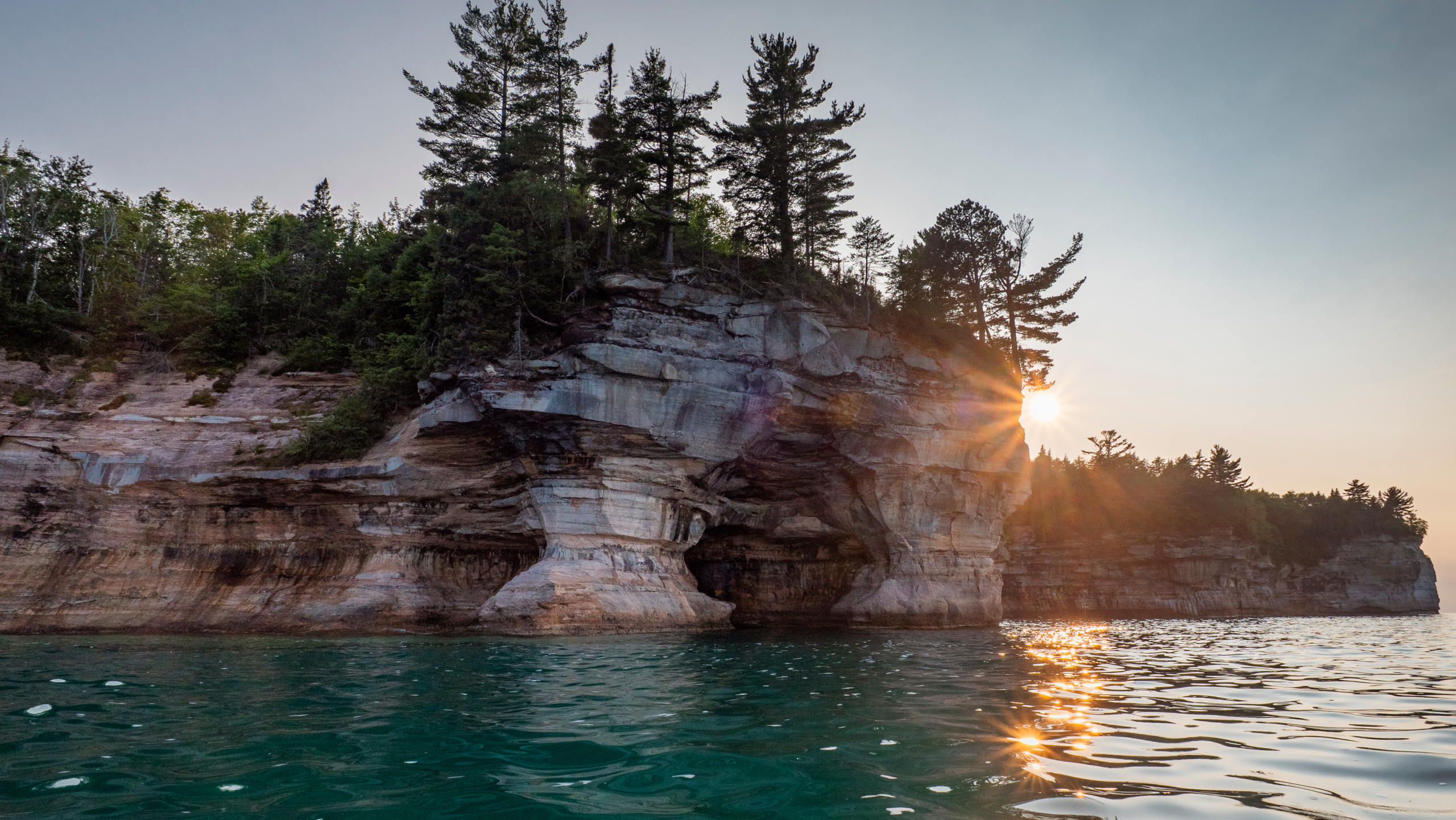
The long winter nights often turn our thoughts toward the sun-drenched summers. We dream of the feeling of warm sand beneath our feet and the sharp, clean scent of a lake breeze. Summer in the Great Lakes isn’t just a season; it is a slower way of being. It is an invitation to breathe with the rhythm of the water and find grounding in a landscape shaped by ice and time.
The following five hikes are more than just scenic overlooks. They are specific journeys that allow you to experience the heritage and scale of the region.
1. The Chapel Loop
Pictured Rocks National Lakeshore, Michigan

Located near Munising, the Chapel Loop is a great introduction to the Pictured Rocks cliffs in a single day. The journey begins at the Chapel-Mosquito trailhead, where you’ll follow a wide, forested path toward the lake. About 1.2 miles in, you will reach Chapel Falls, a 60-foot cascade that signals your transition from the woods to the lakeshore.
Once you hit the coast, the trail follows the cliff tops. This is where you see the famous colored minerals—iron, limonite, and copper—streaking the sandstone. The loop takes you past Chapel Rock, a famous sandstone pillar with a lone pine tree growing on top. From there, the path traces the edge of the cliffs toward Mosquito Beach and Mosquito Falls before looping back through the forest to the parking lot.
- Route Overview: A 10.4-mile loop. It is moderate in difficulty but long, so pack plenty of water. In addition, this is a very popular trail with limited parking spots at the trailhead, so it is recommended to arrive early in the day if you plan to hike here.
- Pro Tip: Look for the “bridge” of roots connecting Chapel Rock to the mainland; it is how the tree on top of the rock gets its nutrients. It is a stunning example of the resilience of the local flora.
2. Meyers Beach Sea Caves
Apostle Islands National Lakeshore, Wisconsin

Located near Cornucopia, the Meyers Beach trailhead is the gateway to some of the most famous geology on Lake Superior. While these caves are world-renowned for the ice formations that draw crowds in the winter, the summer offers a far more peaceful and accessible experience. The hike starts on a flat boardwalk through a hardwood forest before the terrain becomes a bit more rugged with roots and mud.
After about 1.8 miles, the forest floor meets the edge of the sandstone cliffs. This is the “Crevasse,” a narrow fracture in the bedrock where you can look straight down at the water. Continuing another 0.6 miles brings you to the “Bowl,” a natural amphitheater of red arches and sea caves. While the hiking trail offers a bird’s-eye view, launching a sea kayak from the beach below allows you to enter the “rooms” of the caves. At the water level, you can hear the hollow boom of the waves and see the sunlight reflecting off the turquoise water onto the stone ceilings.
- Route Overview:
- On Foot: 3.6 miles round-trip to reach the first cliff-top overlook; 4.8 miles to see the full cave system from above.
- On the Water: A 4-mile round-trip paddle to explore the primary arches, or an 8-mile journey to traverse the entire length of the mainland cliffs.
- Pro Tip: If you choose to kayak, book a guided outfitter in advance. Superior is famously cold, and specialized 16-foot sea kayaks are a safety requirement.
3. Lake Erie Bluffs
Lake County, Ohio

A great option for seeing a diverse range of wildlife, the Lake Erie Bluffs offer a serene, coastal experience that feels more like an ocean escape than a typical Midwest hike. Located within the Lake Metroparks system, the park features a mix of meadows and lakefront forest. The highlight of the journey is the 50-foot Coastal Observation Tower, which sits atop the 40-foot bluffs.
The tower is located just a short quarter-mile walk from the Clark Road entrance. After taking in the 360-degree views, you can follow the interconnected loop trails through the meadows or descend to the quiet, cobblestone beaches below. It is a premier spot for birdwatching, as the thermal winds off the lake make it a favorite corridor for bald eagles and migratory hawks.
- Route Overview: Approximately 3.5 miles of easy, looped trails.
- Pro Tip: The walk-in campsites here are very popular. If you want to stay overnight, book your reservation through Lake Metroparks well in advance.
4. The Three Dunes Challenge
Indiana Dunes State Park, Indiana

This is a short but intense journey located on Trail 8 within the State Park. The challenge requires you to climb the three highest dunes in the park: Mt. Jackson (176 ft), Mt. Holden (184 ft), and Mt. Tom (192 ft). The trail is almost entirely loose sand, making every step upward a workout.
The effort is worth it. At the summit of Mt. Tom, 192 feet above the lake, the view opens up to the entire southern curve of Lake Michigan. On clear summer days, the Chicago skyline is visible in the distance.
- Route Overview: A 1.5-mile loop. It is short but very strenuous due to the vertical sand.
- Pro Tip: Stop by the Visitor Center after your hike to claim your free sticker.
5. Empire Bluffs Trail
Sleeping Bear Dunes National Lakeshore, Michigan

For a hike that delivers a massive payoff for a relatively short walk, Empire Bluffs is unmatched. The trailhead is just south of the village of Empire. You will start with a steady climb through a quiet beech and maple forest. The air is often still here, but as you reach the crest of the hill, the wind from Lake Michigan begins to pick up.
The forest opens onto a high boardwalk perched 450 feet above the water. From this vantage point, you can see the vast “Empire Curve” of the shoreline. To the north are the massive golden dunes of the National Lakeshore, and to the west, South Manitou Island sits on the horizon. It is the perfect place to sit and watch the shifting blues of the water.
- The Route: 1.5 miles round-trip. The trail is easy to moderate with a steady incline.
- Pro Tip: Stay on the designated boardwalk at the overlook. The dune edge is fragile and off-limits to prevent erosion.


