
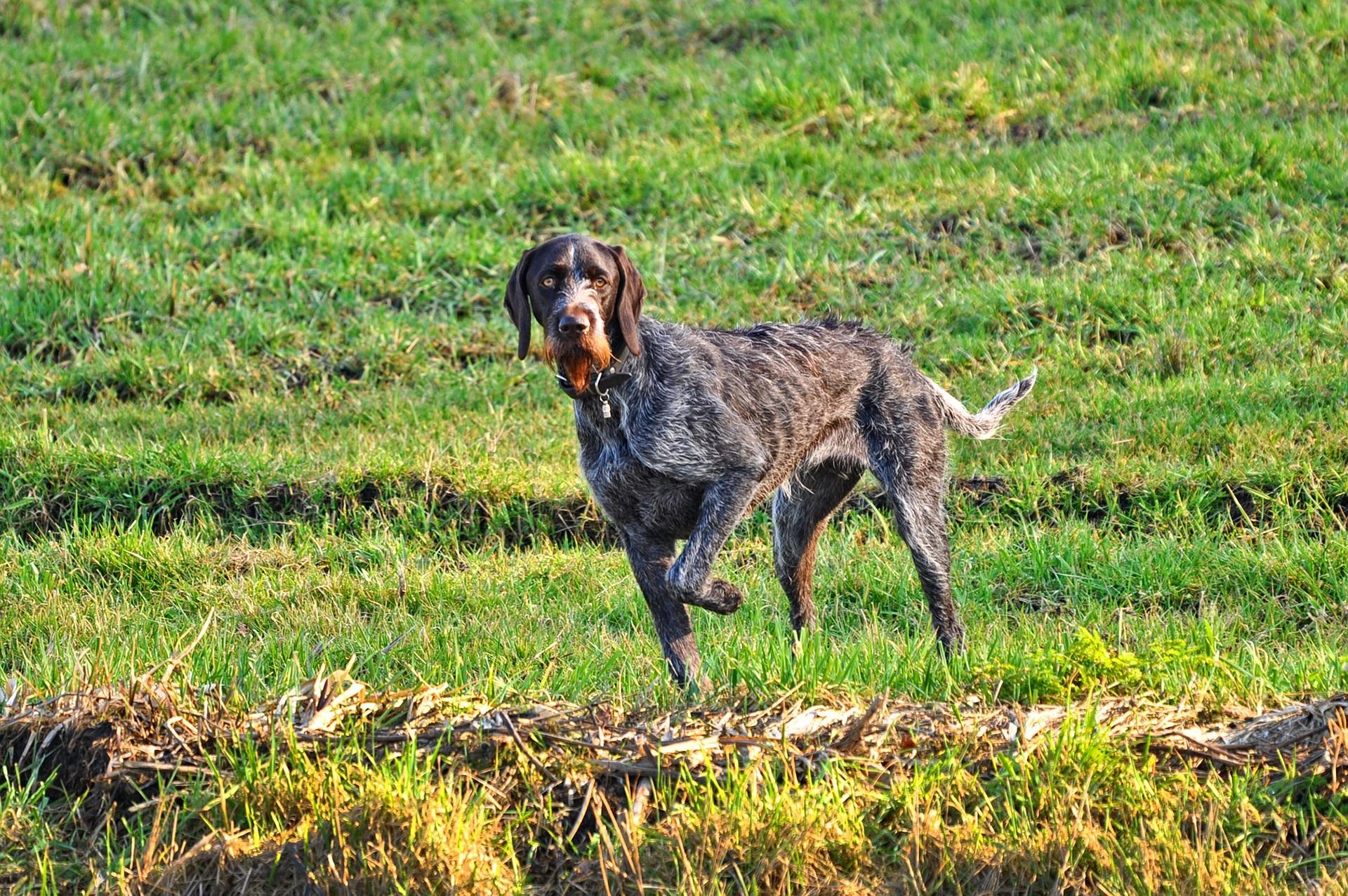
It’s a cold October morning in the north woods. A German Wirehaired Pointer locks up in the thick stems of a post-cut aspen stand outside Marquette. You don’t even need to see the bird to know that it is there. This scene has played out many times across the Great Lakes region. What you may not know is that it took thousands of years of genetic selection, cultural tradition, and careful stewardship to make it possible. The pointing dog connects our region to European bloodlines, industrial-era sporting heritage, and plays an integral role in our conservation efforts.
Before the Gun (Pre-1500s)

The first record of pointing behavior in dogs predates firearms by centuries. One of the first documentations was from 15th-century Spain, which described dogs pointing at partridges while hunters used crossbows to net the birds. These were called “quail dogs” in the Germanic tradition and “net dogs” in Italian, trained to locate game and hold a point so a net could be thrown.
When reliable firearms arrived around 1700, a dog’s ability to remain frozen long enough for a gun to be fired became exceptionally useful. At this time, the English Pointer, descended from greyhounds, bloodhounds, and Spanish lines, emerged as one of the earliest refined pointing breeds. Originally, it worked alongside greyhounds, locating hares for them to chase. The widespread use of the flintlock mechanism in firearms changed this partnership entirely.
Colonial-Era Dogs and New World Birds

It is not exactly known when the first pointing dogs arrived in North America, but it is theorized that they were introduced by either the Spanish, French, or English during the colonial settlement, as they were all enthusiastic hunters.
Important Note: It is worth noting that Europeans were far from the first people in the Americas to hunt with dogs. Native peoples across the continent had long-established relationships with dogs as hunting partners, using them to track and corner large game, dig out burrowed animals, and manage herds. The pointing breeds discussed in this article are a specifically European tradition, arriving with colonial settlement and shaped by centuries of selective breeding on the other side of the Atlantic.
The European settlers were thrilled to find the American Woodcock, which filled the eastern forests. In addition, ruffed grouse, Prairie Chickens, and Sharp-Tailed Grouse offered a new challenge for European hunters. The open prairies required a faster dog with a greater range to cover the ground while the hunter was on horseback. These American-bred dogs became known for their signature vertical “12-o’clock” tail position, which helped them stay visible across open ground.
The upper Midwest and Great Lakes region became home to ruffed grouse and woodcock hunting. These birds love to nest amongst young aspen and birch forests, moist alder drainages, and the brushy edges left behind by decades of logging. The post-cut landscape reshaped the north woods, turning it into a paradise for upland hunters and their dogs.
The Industrial Age and Standardization of the Breed (1850-1920)

By the mid-1800s, standards for the dogs began to be set, and pedigrees were issued. The Field Dog Stud Book, which is still running today, was published in 1874. This was also the first year America held its first trial near Memphis, Tennessee.
The trial was controversial for the country as British hunters tried to suggest that American dogs could not compete with their English counterparts. By 1896, the National Field Trial Championship named Count Gladstone IV, a Llewellin setter who sired a line of national champions, its winner. His body is now mounted in a glass case at the National Bird Dog Museum in Grand Junction, Tennessee.
In the late 1800s, German commoners won the right to own firearms, which sparked the demand for a more versatile hunting dog. Over the next few decades, they used a combination of the Spanish pointers, scent hounds, and English pointers to breed the German Shorthaired Pointer. This dog was bred to find, point, mark, and retrieve on land and water, and was officially recognized in 1879. It would arrive in the United States in the 1920s.
The Brittany, a compact French pointing breed, made its American debut in the early 1930s and quickly found a following in the north woods.
The German Shorthaired Pointer saw a large surge after World War II as Veterans returning from Europe brought the breed home. The economic boom of the 1950s put bird hunting within reach of the middle class. In Toledo, Ohio, a man named Virgil VanDivort, a newspaper circulation manager, started the National German Shorthaired Pointer Association. This club originated from a group of local hunters who used the breed to hunt pheasants in the fields outside the city.
The Great Lakes and the Pointing Dog

Minnesota, Wisconsin, and Michigan together form what many consider the finest ruffed grouse hunting ground on the continent. Michigan alone has 3.9 million acres of state forest land and more than 100,000 acres of state game areas open to public hunting. Wisconsin adds 2.4 million acres of managed county forests.
Hunters have worked alongside the DNR since 1950 to track ruffed grouse population cycles by submitting cooperator survey data, which helps managers understand how each season is shaping up. Price County, Wisconsin, with its 300,000 acres of county forest, has earned a reputation as the Ruffed Grouse Capital of the World.
In addition, the migratory woodcock moves through Michigan and Wisconsin in October, tending to pause amongst the moist alder thickets before moving further south. For pointing dogs, a cold front in late October that triggers this migration is a field day.
Most Popular Breeds in the Great Lakes
Many pointing breeds work well in the region, but these five specific breeds tend to be the most popular as they are well-suited to working in dense cover and hunting the game most prominent in the north woods.
- English Setter — One of the oldest bird dogs in the region, they are built for slow, methodical work in the thick cover of the north woods.
- Brittany — Probably the most common dog you’ll encounter in Wisconsin and Michigan today. These compact breeds handle the dense stems of young aspen well and have the energy for long days in the field.
- German Shorthaired Pointer — This versatile workhorse handles grouse, woodcock, pheasant, and waterfowl, which matters when you’re hunting Michigan’s mixed terrain.
- German Wirehaired Pointer — Built for cold, wet, and heavy cover. The wire coat handles November alder thickets better than most breeds, making them a great choice for late-season hunting.
- Wirehaired Pointing Griffon — Similar utility to the GWP but with its own distinct heritage. This breed is growing in popularity among hunters, specifically those in the UP, who want a slower, closer-working dog in tight cover.
Modern Conservation Efforts
Young forests, including aspen and birch regeneration that grouse and woodcock depend on, are declining. Wisconsin has lost 1.4 million acres of zero-to-20-year old forest since the early 1980s. This has caused ruffed grouse populations to drop 30-50% in some areas. Pointing-dog hunters are working hard with state DNRs to help reverse this population decline. Their efforts include advocating for timber sales and clearcuts, which actually accelerate aspen regeneration.
Conclusion
As I finish this piece, I glance across my office at my English Lab, who is loudly snoring while asleep on her back in the chair, all four paws in the air. Her bloodline was built for hunting, with a great-grandfather of hers having been featured by ESPN for his instincts in the field. Somewhere along the way, she became our family’s 60-pound lap dog instead. It is a good reminder that genetics alone do not make a bird dog. The partnership between hunter and dog, the training, the trust, the hours in the field, is what has made this tradition work for centuries. That has not changed, and if the hunters and conservationists of the Great Lakes have anything to say about it, neither will the forests that make it possible.
Interested in learning more about Great Lakes hunting traditions? Read our article on A Beginner’s Guide to Clay Shooting here.
Sources
- DeRosa, A.J. “The History of Early American Hunting Dogs.” Project Upland, August 2025. projectupland.com
- Wapenski, Jennifer. “Origins of the Pointing Dog.” Hunting Dog Confidential, Project Upland, Episode 1. projectupland.com
- Wapenski, Jennifer. “The Golden Age of Hunting Dogs in North America.” Hunting Dog Confidential, Project Upland, Episode 30. projectupland.com
- “Pointing Dog Origins.” Woods N Water News, September 2024. woods-n-waternews.com
- “The History of the Retriever.” Ducks Unlimited, October 2018. ducks.org
- “German Shorthaired Pointer History.” American Kennel Club. akc.org
- “Origins of the German Shorthaired Pointer.” Project Upland. projectupland.com
- “History.” National German Shorthaired Pointer Association. ngspa.org
- “F&S Report: The National Championship for Field Trialing Bird Dogs.” Field & Stream. fieldandstream.com
- Leopold, Aldo. A Sand County Almanac. Oxford University Press, 1949.
- “Aldo Leopold: Wisdom of a Ruffed Grouse Hunter.” Project Upland, October 2021. projectupland.com
- “Ruffed Grouse Hunting Great Lakes Guide.” Nimrods, March 2026. kb.nimrods.ai
- “2025 Great Lakes Region Ruffed Grouse Forecast.” Outdoor News, August 2025. outdoornews.com
- “Upland Bird Hunting in Wisconsin.” Project Upland, August 2025. projectupland.com
- Michigan Department of Natural Resources. “Hunters Invited to Use New Online Survey to Report Ruffed Grouse and American Woodcock Hunting Activity.” September 2025. michigan.gov/dnr
- “Decline of Ruffed Grouse Linked to Loss of Young-Forest Habitat.” Bay Journal, March 2020. bayjournal.com


