
Pack your cooler, top off the tank, and spend a long weekend (or a full week) gallery-hopping across the Great Lakes region. From contemporary art fairs in Cherry Orchard Country to sculpture gardens overlooking Lake Superior, these are the spots that prove the Midwest’s creative scene is anything but flyover.
This isn’t a list of the obvious big-city institutions (though a couple of those earned spots). This is a guide to the galleries, art centers, and creative communities that feel unique to this place, rooted in the landscapes and small towns that define the Great Lakes region. We mapped them into a drivable loop so you can hit every single one, or cherry-pick a few that match your route this summer.
1. Saugatuck and Douglas, Michigan
There’s a reason this stretch of Lake Michigan shoreline has been called the Art Coast of Michigan since the early 1900s. Artists from the School of the Art Institute of Chicago established colonies here more than a century ago, drawn by the dunes, the dramatic light, and a community that valued what they were doing. That creative DNA still runs through every block of downtown Saugatuck and Douglas.
Start at J. Petter Galleries, the longest-running fine art gallery on the Art Coast, which occupies a sprawling space between the two towns and pairs its collection of paintings, sculptures, and glassworks with a wine bar. Yes, you can sip a local pour while contemplating a piece from one of over 100 represented artists. From there, walk Butler Street and hit the smaller owner-operated studios. Capizzo in Douglas runs a packed 2026 exhibition calendar, with solo shows rotating every two weeks through the summer and a Detroit Group Show in August. The Ox-Bow School of Art and Artists’ Residency, connected to the School of the Art Institute, still operates on the same wooded campus it has used since 1910. Check their public programming for open studio events.
Don’t miss: The second Saturday gallery strolls in Douglas, which run monthly through the season. Oval Beach, a short walk from downtown, consistently ranks among the best beaches on the Great Lakes.
2. Frederik Meijer Gardens & Sculpture Park, Grand Rapids, Michigan
Frederik Meijer Gardens and Sculpture Park sits on 158 acres on the northeast side of Grand Rapids and holds one of the most significant sculpture collections in the country. With major works by Auguste Rodin, Henry Moore, Claes Oldenburg, Ai Weiwei, and Louise Bourgeois, placed throughout indoor galleries and across rolling outdoor grounds that shift with the seasons.
Don’t miss: They have a special exhibit by Dale Chihuly running this year from May through November 2026.
The outdoor sculpture experience is what sets this place apart from a traditional museum. Paths wind through woodland, prairie, and manicured garden spaces, with large-scale works appearing around bends and across meadows. The Richard and Helen DeVos Japanese Garden is one of the most authentic outside of Japan, designed by renowned artist Hoichi Kurisu. Inside, the tropical conservatory houses five stories of plants under glass, and rotating exhibitions bring in national and international shows throughout the year.
Summer is peak season here. The grounds are fully green, the outdoor installations are all accessible, and the concert series brings live music to the amphitheater on warm evenings. Plan for at least three hours, even more if you’re a photographer or want to walk every path.
Don’t miss: The sculpture collection in the Fred and Lena Meijer wing, and the Children’s Garden if you have kids in tow.
3. Muskegon Museum of Art, Muskegon, Michigan
Just an hour north of Saugatuck, the Muskegon Museum of Art recently completed a $15.4 million renovation that doubled its size. The expansion added new gallery space, improved accessibility, and created room for a deeper rotation of its permanent collection alongside traveling exhibitions.
Muskegon itself is an underrated Lake Michigan town with soft sand beaches and a waterfront that catches spectacular sunsets. If you time it right, the Lakeshore Art Festival (usually late June) brings 100 juried fine art exhibitors and another 160 craft and food vendors to the area near the museum. It’s one of the strongest art festivals on the Michigan lakeshore and is easy to pair with a museum visit.
Don’t miss: The SS Milwaukee Clipper, known as the “Queen of the Great Lakes,” is a restored Great Lakes cruise ship and is docked in the harbor. A great stop for those wanting history and art in the same afternoon.
4. Crooked Tree Arts Center, Petoskey, Michigan
Head north through Traverse City (stop at the Dennos Museum Center on the Northwestern Michigan College campus if you have time; their Inuit art collection is one of the largest and most historically complete collections) and continue up US-31 to Petoskey. Crooked Tree Arts Center has been a cultural anchor in northern Michigan since 1971, with campuses in both Petoskey and Traverse City. Galleries are always free and open to the public.
Don’t miss: Walk the Petoskey waterfront and hunt for Petoskey stones (the state stone of Michigan). The Gaslight District downtown has bookshops and cafes that are worth an hour of wandering.
5. Glen Arbor Arts Center, Glen Arbor, Michigan
Tucked into the Sleeping Bear Dunes National Lakeshore corridor, the Glen Arbor Arts Center is a small community arts space that punches well above its weight. Rotating exhibitions feature regional artists, and the center runs workshops in everything from printmaking to plein air painting. It’s also the kind of place where an artist might be sitting in the corner, happy to talk about the work.
Glen Arbor itself is a one-stoplight town surrounded by some of the most cinematic dune landscapes in the Great Lakes. The Pierce Stocking Scenic Drive puts you at the top of 450-foot sand bluffs overlooking the Manitou Islands.
Don’t miss: The Empire Bluff Trail, about 1.5 miles round trip, ends at a boardwalk overlook with a panorama of Lake Michigan. We recommend going at sunset if you can.
6. Detroit Institute of Arts, Detroit, Michigan
The DIA collection spans 65,000 works across centuries and continents, but two things make it essential for a Great Lakes gallery trip specifically. First, the Diego Rivera Detroit Industry Murals, a 27-panel cycle that captures the industrial soul of the region. Second, the museum’s ongoing commitment to contemporary work rooted in place: their most recent exhibition, “Contemporary Anishinaabe Art: A Continuation” (ended April 2026), centered on Indigenous artists whose work speaks directly to Great Lakes history and identity. See their upcoming exhibitions here.
The DIA sits in the Midtown neighborhood, surrounded by cultural institutions that help make up the heart of the city’s identity: the Charles H. Wright Museum of African American History, the Michigan Science Center, and the main branch of the Detroit Public Library are all within walking distance.
Don’t miss: Corktown and Eastern Market, two neighborhoods where Detroit’s creative energy is most visible. Eastern Market’s Saturday market is the oldest and largest in Michigan.
7. Milwaukee Art Museum, Milwaukee, Wisconsin
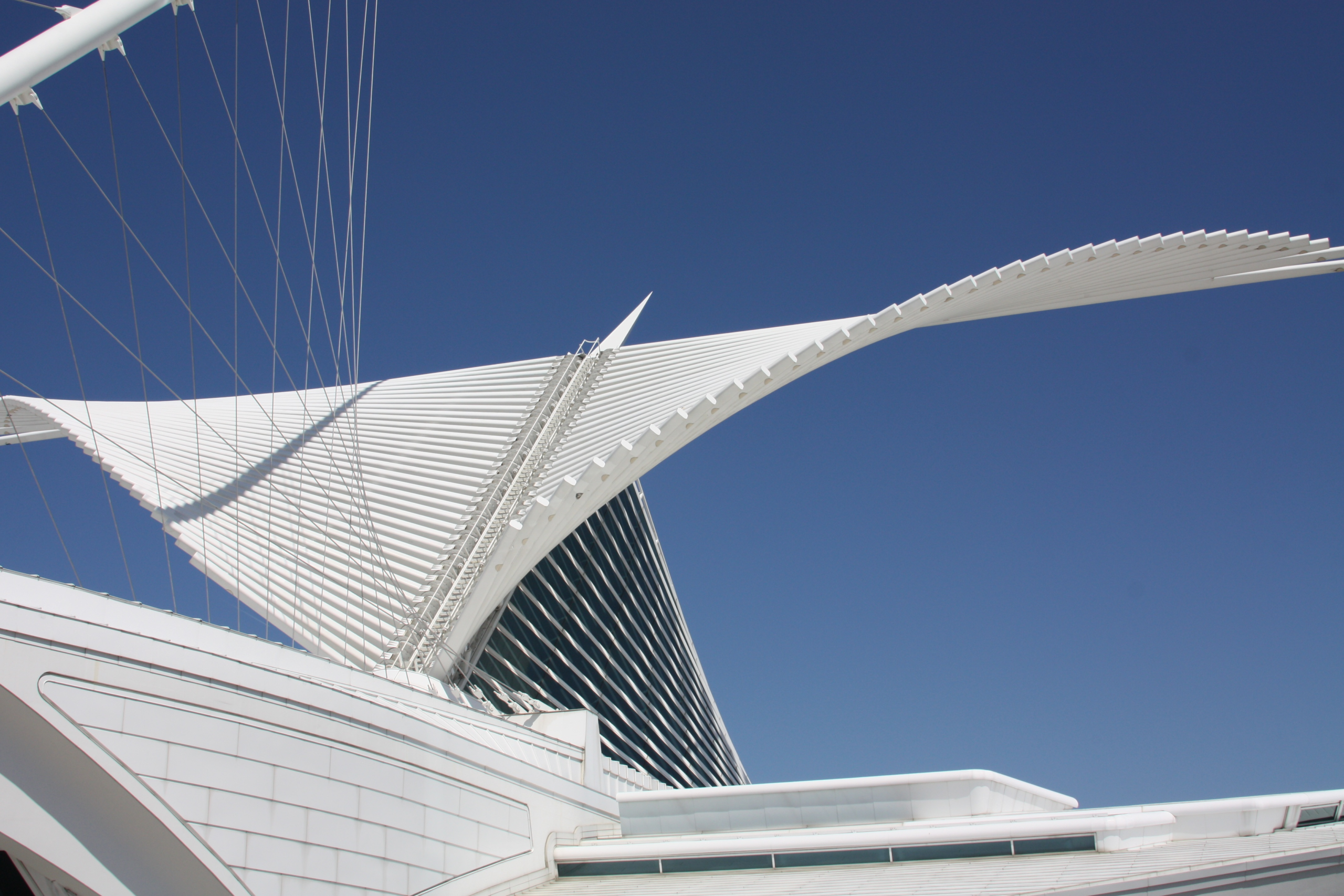
Cross Lake Michigan (take the SS Badger from Ludington to Manitowoc if you want the full Great Lakes experience; the 2026 sailing season is already underway through October 11) and head south to Milwaukee. The Milwaukee Art Museum building itself is worth a stop. Santiago Calatrava’s Quadracci Pavilion, with its 217-foot wingspan, Burke Brise Soleil that opens and closes like a pair of wings, sits right on the Lake Michigan shoreline. It’s among the most photographed buildings in the Midwest.
Inside, the museum holds more than 34,000 works, including one of the largest collections of Georgia O’Keeffe paintings in the country. The Lakefront Festival of Art, held on the museum grounds every summer, brings more than 140 juried artists from across the country and pairs art with live performances and tastings. Milwaukee’s broader gallery scene, especially in the Third Ward and Bay View neighborhoods, is worth a full afternoon of exploring.
Don’t miss: The Grohmann Museum at the Milwaukee School of Engineering, which houses an extraordinary collection of art themed around human work and industry.
8. Peninsula School of Art and Door County Contemporary, Fish Creek, Wisconsin
Door County has been drawing artists since the 1920s, and the Peninsula School of Art (PenArt) in Fish Creek is a major part of that tradition. PenArt offers classes, residencies, and gallery exhibitions year-round, but the reason it’s on this list right now is the Door County Contemporary art fair, returning June 4-7, 2026, for its second year.
The inaugural DCC in 2025 drew over 3,400 attendees and 20 exhibiting galleries, generating more than $120,000 in art sales. The 2026 edition expands to 26 galleries and 4 nonprofits, with site-specific sculpture, curated outdoor spaces, and partnerships with major art institutions. Cofounder Shane McAdams calls Fish Creek “a nest of leisure comfort” and timed the fair for early June intentionally, just before the summer crowds arrive.
Don’t miss: Drive up the peninsula to Ephraim and Sister Bay for more galleries, then catch the cherry orchards in bloom (peak is usually mid-May, but late bloomers can linger into early June).
9. Walker Art Center and Minneapolis Sculpture Garden, Minneapolis, Minnesota
The Walker is one of the most visited modern and contemporary art museums in the country, and the adjacent Minneapolis Sculpture Garden is its free, 11-acre outdoor counterpart. The Spoonbridge and Cherry sculpture has become one of the most iconic public artworks in the Midwest, but the garden holds more than 60 large-scale works that reward a slow stroll.
Inside, 11 galleries rotate exhibitions by emerging and established artists. Free admission is available every Thursday after 5 p.m. and on the first Saturday of each month. The Walker Cinema, McGuire Theater, and the restaurant Cardamom (run by chef Daniel del Prado) make this a place you could easily spend half a day.
The Walker is also a Blue Star Museum, so active-duty military and their families get free admission from Armed Forces Day in May through Labor Day in September.
Don’t miss: The Midtown Greenway bike trail runs nearby, connecting the Walker to the Chain of Lakes. Rent a bike and ride to Lake Harriet for a swim after your gallery visit.
10. Duluth Art Institute and North Shore Galleries, Duluth to Grand Marais, Minnesota
End your trip where the Great Lakes can feel the biggest. Lake Superior’s North Shore, stretching from Duluth to Grand Marais along Highway 61, is one of the most scenic drives on the continent, and the art scene along it is more vibrant than most people realize.
The Duluth Art Institute’s current Annual Member Show runs through July, featuring work by regional artists. Up the shore, the Tweed Museum of Art at the University of Minnesota Duluth hosts its Annual Student Exhibition through May, spotlighting emerging talent in everything from ceramics to video art.
Grand Marais, the small harbor town 110 miles northeast of Duluth, is a real treat. The Grand Marais Art Colony, founded in 1947, is the oldest arts school in the state and offers workshops all summer. The North House Folk School teaches traditional northern crafts in a waterfront setting. Small galleries dot the harbor area, and the town has a creative density that rivals places ten times its size. The combination of Superior’s moody presence, the boreal forest, and a community that genuinely supports working artists makes Grand Marais one of the best small art towns in the country.
Don’t miss: The Sivertson Gallery on the harbor for fine art rooted in the North Shore landscape. Grab a donut at World’s Best Donuts (be sure to get in line early) and eat it on the breakwater while watching the lake.
How to Road Trip the Best Midwest Art Galleries in One Loop
For those who want to hit all 10 stops, here’s a drivable route that forms a rough loop through Michigan, Wisconsin, and Minnesota. Total driving time is approximately 28 to 30 hours, best spread across 7 to 10 days, depending on how long you want to spend at each stop.
Day 1: Saugatuck/Douglas, MI Arrive and spend the afternoon gallery-hopping on Butler Street and the Art Coast before spending the evening on Oval Beach.
Day 2: Grand Rapids, MI then Muskegon, MI Morning at Frederik Meijer Gardens and Sculpture Park (about 1 hour north of Saugatuck). Afternoon drive to Muskegon (45 minutes west) for the Muskegon Museum of Art and the Lake Michigan waterfront. Overnight in Muskegon before heading north.
Day 3: Traverse City to Petoskey, MI Morning at the Dennos Museum Center in Traverse City (2.5 hours north). Afternoon at Crooked Tree Arts Center in Petoskey (1 hour north). Overnight in Petoskey or Harbor Springs.
Day 4: Glen Arbor, MI Backtrack south to Glen Arbor (about 1.5 hours). Morning at the Glen Arbor Arts Center, afternoon on the Pierce Stocking Scenic Drive and Empire Bluff Trail. Overnight near Sleeping Bear Dunes.
Day 5: Detroit, MI Long drive day (4.5 hours southeast). Spend the afternoon and evening at the DIA, Corktown, or Eastern Market (Saturday only). Overnight in Detroit.
Day 6: Cross Lake Michigan to Milwaukee, WI Option A: Drive around the bottom of the lake (about 5 hours) through Indiana. Option B: Drive to Ludington (3.5 hours) and take the SS Badger across to Manitowoc (4-hour crossing), then drive south to Milwaukee (1.5 hours). Afternoon/evening at the Milwaukee Art Museum and Third Ward galleries.
Day 7: Door County, WI Drive north to Fish Creek (3.5 hours). Peninsula School of Art and Door County galleries. Try to line your timing up with the Door County Contemporary fair (June 4-7). Overnight in Fish Creek, Ephraim, or Sister Bay.
Day 8: Drive to Minneapolis, MN, from Wisconsin (4.5 hours). Afternoon at the Walker Art Center and Minneapolis Sculpture Garden. Dinner in the North Loop. Overnight in Minneapolis.
Day 9-10: Duluth to Grand Marais, MN (North Shore) Drive to Duluth (2.5 hours). Morning at the Duluth Art Institute. Then follow Highway 61 north to Grand Marais (2 hours of the best lakeshore driving in the country). Spend a day at the Grand Marais Art Colony, North House Folk School, and harbor galleries before heading home.
Planning Notes
Best timing: Late May through mid-September gives you the widest access to seasonal galleries and outdoor events in the Midwest. Early June is particularly strong, with the Door County Contemporary fair (June 4-7), the start of Saugatuck’s summer gallery stroll season, and the North Shore fully open.
SS Badger crossings: The ferry runs daily from May 15 through October 11, 2026. Overnight crossings are available June 19 through September 7. Book ahead for vehicle spots, especially on weekends. The crossing itself includes 60 miles of open Lake Michigan and is one of the best experiences on the Great Lakes.
Pack layers. Even in July, a Lake Superior evening can drop into the 50s. And bring a sketchbook or a journal, as you’re sure to be feeling inspired after taking in so much art and dramatic landscapes.


