
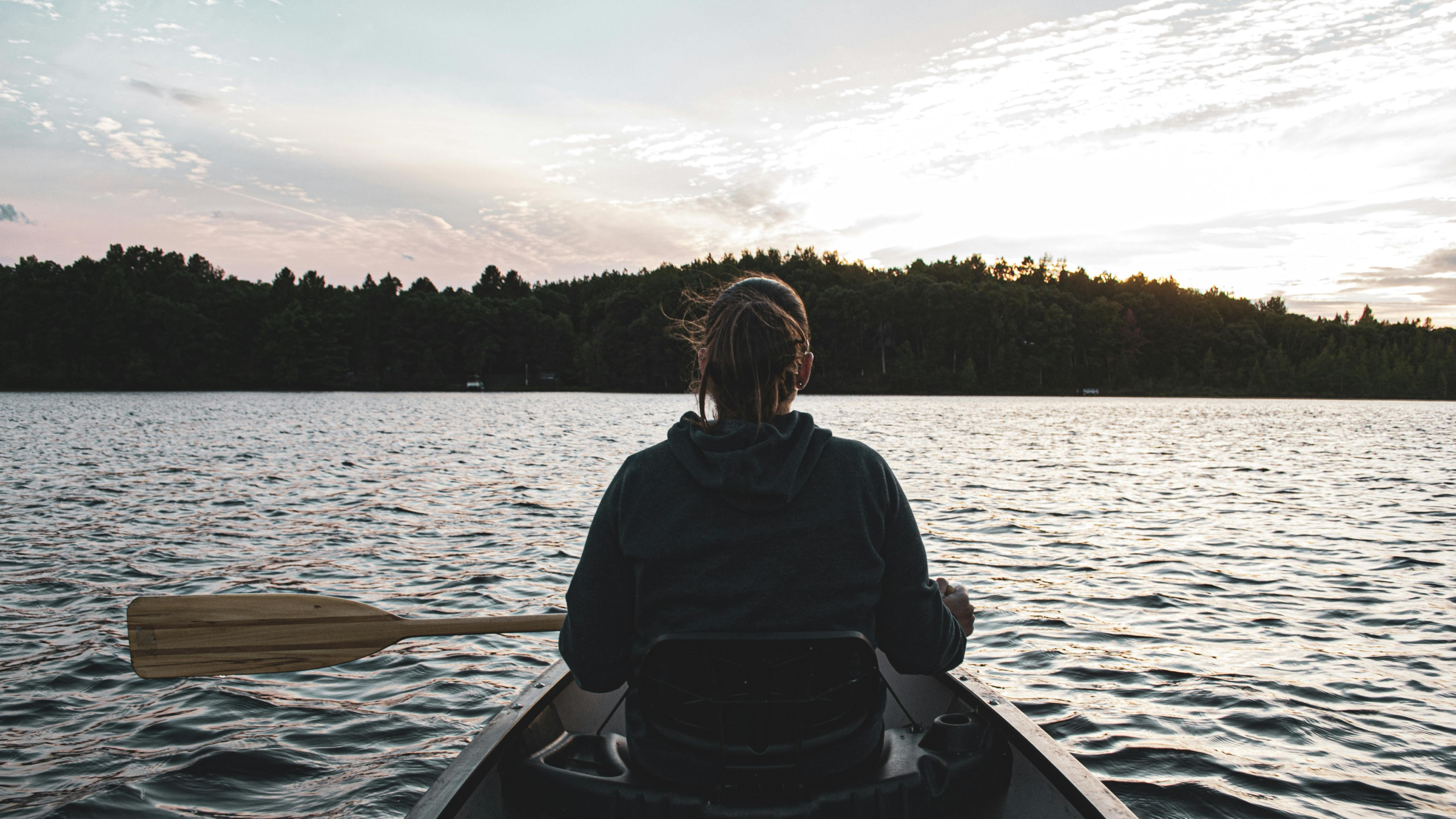
What makes the Boundary Waters Canoe Area Wilderness (BWCAW) unlike anything else is its continuity. Today’s paddlers cross the same lakes, follow the same portage trails, and camp on the same granite ledges that Anishinaabe travelers, voyageur fur traders, and conservation pioneers like Sigurd Olson used for centuries. This tradition is simultaneously recreational, spiritual, and political. It is inseparable from the conservation movement that fought for over 75 years to protect this breathtaking landscape.
The annual canoe trip into Minnesota’s Boundary Waters Canoe Area Wilderness is one of America’s oldest and most deeply rooted outdoor traditions. It traces an unbroken line from Indigenous peoples and French-Canadian voyageurs through early 20th-century conservationists to the quarter-million visitors who paddle these routes each year today. The BWCAW’s 1,098,057 acres and 1,200 miles of canoe routes form the most visited wilderness in the United States, and is the only major wilderness area whose primary mode of travel remains the canoe.
Ten Thousand Years of Travel by Water
The canoe tradition in what is now the BWCAW predates European contact by millennia. Archaeological evidence reveals Paleo-Indian cultures inhabiting the region 10,000–12,000 years ago. The Anishinaabe people built an entire civilization around birch bark canoe travel on the interconnected waterways. Hundreds of prehistoric pictographs, including the renowned Hegman Lake pictographs depicting moose, human figures, and canoes painted 500–1,000 years ago, testify to this deep Indigenous presence.
A Note on Terminology
The term “Anishinaabe” refers to a broad group of Indigenous people extending across the Great Lakes and Saint Lawrence River region of the United States and Canada. The terms “Ojibwe” and “Chippewa” are often used to identify Anishinaabe people in what is today Minnesota, Wisconsin, and northern Michigan.
Following the guidance of Friends of the Boundary Waters Wilderness, Highland & Harbor acknowledges that it is not for outside organizations to apply terminology to Native people, but to ask, learn, and recognize the self-descriptors that Native people apply to themselves, both individually and collectively.
The French-Canadian voyageurs transformed these Indigenous travel routes into a continental commerce network beginning in the late 1600s. Explorer Jacques de Noyon became the first European to travel through the area in 1688. By the late 18th century, hundreds of voyageurs paddled 36-foot birch bark freight canoes for the North West Company and Hudson’s Bay Company, carrying 90-pound packs over portages and paddling up to 16 hours a day. Their routes became so well established that they defined the international boundary between the United States and Canada. The final fur trade rendezvous at Grand Portage occurred in 1803, and by 1840, the trade had collapsed, but the water highways remained.
Modern recreational canoe tripping began taking shape in the early 1900s. Minnesota Forest Commissioner Christopher C. Andrews paddled through the area in 1902 and persuaded the state to reserve 500,000 acres from logging. President Theodore Roosevelt established the Superior National Forest in 1909. The pivotal moment came when Arthur Carhart, the Forest Service’s first landscape architect, completed two 21-day canoe trips in 1919 and 1921. Carhart produced the first formal recreation plan for any National Forest, writing that the Superior, as a canoe country, would have few competitors. His radical recommendation to preserve the area rather than build roads helped launch the American wilderness movement.

The Visionaries Who Saved the Canoe Country
These figures helped to build and protect the Boundary Waters Canoe Area Wilderness, each contributing something essential and irreplaceable.
Sigurd F. Olson (1899–1982)
Olson was a poet, philosopher, and one of the most eloquent defenders of the area. A biology teacher and wilderness guide who moved to Ely in 1923, he spent decades paddling the border lakes before publishing his first book, The Singing Wilderness, in 1956. His eight books reached millions of readers and articulated a spiritual philosophy of canoe travel that became central to American wilderness thought.
There is magic in the feel of a paddle and the movement of a canoe, a magic compounded of distance, adventure, solitude, and peace.

— Sigurd F. Olson
Olson served as president of both The Wilderness Society and the National Parks Association, helped draft the 1964 Wilderness Act, and testified for full BWCA protection in 1977. He received the highest awards from four of the five largest U.S. conservation organizations and the John Burroughs Medal for nature writing. He died of a heart attack while snowshoeing near his Ely home on January 13, 1982.
Ernest Oberholtzer (1884–1977)
Oberholtzer was the region’s political champion. A Harvard graduate who first paddled the border lakes in 1906, he was told by a doctor he had a year to live; he responded by paddling 3,000 miles of the Rainy Lake watershed in 1909 and lived to age 93. When industrialist Edward Backus proposed dams that would raise water levels by 80 feet, Oberholtzer co-founded the Quetico-Superior Council in 1928 and led the fight that produced the Shipstead-Newton-Nolan Act of 1930 — the first U.S. statute in which Congress explicitly ordered federal land preserved as wilderness. The Ojibwe honored him with the name Atisokan, meaning storyteller.
Miron “Bud” Heinselman (1920–1993)
A Forest Service research scientist, Heinselman, mapped the BWCA’s remaining virgin forests and reconstructed its fire history back to 1595. He took early retirement in 1974, becoming the only professional forester to oppose Forest Service logging in the BWCA publicly, and co-founded Friends of the Boundary Waters Wilderness in 1976. He then spent months in Washington, D.C., carrying rolled maps through Capitol hallways, leading the citizen campaign that produced the landmark 1978 BWCA Wilderness Act.
Bill Rom (1917–2008)
Bill founded Canoe Country Outfitters in 1946 and built it into the world’s largest canoe outfitting operation with over 600 rental canoes. He testified repeatedly for wilderness protection, enduring an explosive detonation near his home, snowmobiles circling his house at night, and logging trucks blockading his business. His daughter Becky Rom continues as a leading BWCA advocate today.
Dorothy Molter (1907–1986)
Known as the “Root Beer Lady,” Dorothy lived on Knife Lake’s Isle of Pines from 1934 until her death, brewing homemade root beer for up to 7,000 canoe visitors per year. She became the BWCA’s most beloved character and the last private resident in the wilderness. Her cabins were transported by dogsled to Ely after her death. They now form the Dorothy Molter Museum.
Conservation and the Canoe
The BWCAW’s conservation history is unique because the canoe trip tradition was not merely a byproduct of protection; it was the primary argument for it. Every major legislative victory was driven by the premise that the area’s highest value lay in canoe-based wilderness recreation.
- 1902: Minnesota reserves 500,000 acres from logging after Christopher C. Andrews’ canoe survey.
- 1909: President Roosevelt establishes the Superior National Forest.
- 1926: Secretary of Agriculture Jardine establishes a 640,000-acre roadless wilderness area.
- 1930: The Shipstead-Newton-Nolan Act becomes the first congressional statute explicitly preserving federal land as wilderness.
- 1949: President Truman signs Executive Order 10092 banning flights below 4,000 feet, making the BWCAW the only wilderness with an airspace reservation.
- 1964: The Wilderness Act includes the BWCA in the National Wilderness Preservation System.
- 1978: The BWCA Wilderness Act adds 50,000 acres, bans logging and mining, phases out most motorized use, and establishes the permit quota system.

Camps and Organizations That Built and Continue the Tradition
Organized youth wilderness canoe tripping in the BWCA dates to the early 1920s and represents one of the longest continuous outdoor education traditions in America.
Northern Tier High Adventure (Boy Scouts of America) was founded in 1923 when scout commissioner Carlos S. Chase organized a canoe trip from Winton, Minnesota. By 1932, the program contracted with Sigurd Olson himself to provide outfitting services. Today it outfits over 4,000 Scouts annually from its Ely base, sending crews on 6–14 day expeditions of 50–150 miles.
YMCA Camp Menogyn, founded in 1922 on West Bearskin Lake along the Gunflint Trail (accessible only by water), is one of the oldest continuously operating canoe camps in the country. Its progressive camping program sends groups on trips ranging from 8-day introductions to 30-day Nor’Wester expeditions.
YMCA Camp Widjiwagan, founded in 1929 by Julian Kirby on Burntside Lake near Ely, is often called the “Keepers of the Boundary Waters.” The camp maintains what is reportedly the world’s largest fleet of handmade wood-canvas canoes, some built by legendary craftsman Joe Seliga of Ely, and sends groups of 4–6 teens on trips of 9–48 days. Some families have sent four generations of campers.
Other significant programs include the Voyageur Outward Bound School (founded 1963, the first Outward Bound school to put girls on course in 1965), the Wilderness Canoe Base (Lutheran, operating over 60 years at the end of the Gunflint Trail), and Wilderness Inquiry (founded 1978, pioneering inclusive wilderness trips helping over 1,000 wheelchair users to paddle the Boundary Waters).

Rituals, Customs, and the Culture of the Paddle
The BWCA canoe trip carries a rich web of traditions, some inherited from Indigenous peoples and voyageurs and some evolved organically over generations of wilderness travel.
At the historic Height of Land Portage, crossing the Laurentian Divide between the Great Lakes and Hudson Bay watersheds, voyageurs initiated newcomers by sprinkling them with water from a cedar bough, extracting an oath to perform the same ceremony for future novices, firing a gun salute, and sharing rum. The initiate earned the title Homme du Nord. Modern paddlers consciously retrace these same routes.
The walleye shore lunch is a quintessential BWCA food tradition. Few things taste better than catching fresh walleye, filleting them lakeside, and frying them in butter or oil over a campfire. Bannock, trail bread baked in a pan over fire, is a voyageur staple that continues to survive in modern camp kitchens.
The transition from heavy Grumman aluminum canoes to ultralight Kevlar canoes (32–42 pounds) revolutionized BWCA travel and dramatically reduced the physical barrier to entry. The iconic Duluth pack, a square canvas or nylon sack designed for efficient canoe loading, remains the traditional portage pack.
And the call of the common loon at dusk across a still lake is the near-universal acoustic signature of the BWCA experience, a sound that Sigurd Olson wrote about as connecting paddlers to something ancient and fundamental.

Classic Routes and the Geography of Tradition
The BWCAW’s approximately 80 entry points provide access to a vast network of lakes, rivers, and portages. Several carry outsized historical and recreational significance.
Entry Point 25 – Moose Lake is the most popular starting point in the Boundary Waters, with up to 27 daily permits. Located near Ely with no initial portage required, it provides access to the Knife Lake route and serves as the gateway to Quetico Provincial Park via Prairie Portage.
Entry Point 30 – Lake One is the classic beginner route through Lakes One, Two, Three, and Four with minimal portaging.
Entry Point 24 – Fall Lake launches the famous Basswood Lake loop.
Entry Point 38 – Sawbill Lake offers access to the quieter eastern wilderness.
The most historically significant portages include the Grand Portage (8.5 miles, now a National Monument), the original overland connection for the North West Company’s fur operations, and the Height of Land Portage (a National Register Historic Site and location of voyageur initiation ceremonies).
Basswood Lake, the BWCAW’s largest, once hosted resorts and a ranger station.
Knife Lake, 15 miles from the nearest road, carries Dorothy Molter’s legacy.
Lac La Croix stretches 30 miles along the border with notable pictographs on its cliff faces.
The Gunflint Trail, a 57-mile Minnesota Scenic Byway from Grand Marais, provides access to 19 entry points and has been designated a National Scenic Byway.
Permitting: Then and Now
Access to the Boundary Waters has evolved from completely unregulated to one of the most carefully managed permit systems in American wilderness. The first travel permits were required in 1966, a simple registration system. The 1978 BWCA Wilderness Act established the framework for the current quota system, restricting group sizes and daily entries at each entry point.
By the Numbers
The BWCAW receives approximately 250,000 total visitor-days annually, making it the most heavily used wilderness in the National Wilderness Preservation System — roughly 10% of all U.S. wilderness visits despite representing less than 1% of wilderness acreage.
The COVID-19 pandemic triggered a dramatic surge with over 166,000 overnight visitors in 2021, the highest on record, prompting a quota reduction of approximately 13% in 2022. Visitation has since stabilized at roughly 150,000 overnight visitors per year.
How to Plan Your Trip: A Practical Guide
Whether you’re planning your first trip or looking to deepen an existing connection to this wilderness, here is a practical roadmap for getting into the Boundary Waters today.
Getting There
Ely, Minnesota, is the primary gateway to the area. Most paddlers drive up the day before and stay overnight in Ely, with many outfitters offering bunkhouse lodging the night before departure.
Securing Your Permit
All overnight trips during quota season (May 1 – September 30) require a reserved permit through Recreation.gov. Permits for the entire season are released on a first-come, first-served basis at 9:00 AM Central Time on the last Wednesday of January. There is no lottery. Fees are $16 per adult and $8 per youth per trip, plus a $6 non-refundable reservation fee. Each permit covers up to 9 people and 4 watercraft and is tied to a specific entry point and entry date.
Popular entry points and weekend dates fill within minutes; midweek dates and less popular entry points are far easier to secure. Canceled permits return to the system regularly, so checking Recreation.gov frequently can yield openings even in mid-summer.
Outfitting Options
| Option | What’s Included | Approx. Cost |
|---|---|---|
| Complete Outfitting | Canoe, all gear, food, maps, route consultation, shuttle | $75–$130 per person/day |
| Guided Group Trips | Open-enrollment trips led by experienced guides; all gear included | $1,000–$2,095 per person (trip-length dependent) |
| Partial Outfitting | Canoe rental only, or food pack only; you bring the rest | $35–$60/day for canoe rental |
| Self-Guided | Permit only; bring all your own gear and food | $22 permit fee + personal gear and food costs |
Major Ely outfitters include Piragis Northwoods Company, Boundary Waters Outfitters, Canoe Country Outfitters, and North Country Canoe Outfitters.
Best Entry Points for First-Timers
Lake One (EP 30) for a gentle chain of numbered lakes with minimal portaging. Moose Lake (EP 25) for no initial portage and maximum route options. Sawbill Lake (EP 38) for quieter eastern routes. Fall Lake (EP 24) for the Basswood border experience.
When to Go
June through August offers warmth and long days, with peak bugs from mid-June through mid-July (DEET, bug shirts, and head nets are essential). Late August and September are widely considered the finest window with diminishing bugs, thinning crowds, emerging fall colors, and excellent fishing. May offers solitude and great fishing, but comes with cold water and temperatures.
Annual Trips and Events You Can Join
Several specifically named annual events and open-enrollment trips provide structured ways to participate in the tradition without having to organize a group from scratch.
Wilderness Inquiry Boundary Waters Paddle Adventure runs multiple summer departures of 5–7 days, starting around $1,040 per person, open to individuals of all abilities and experience levels. Transportation is available from Minneapolis.
Piragis Guided Group Trips offer themed departures throughout the season, including “Women Exploring the Wilderness,” “Summer Solstice,” “Sigurd Olson” basecamp trip, “Waterfalls and Pictographs,” and “Autumn Colors.” Pricing runs $1,695–$2,095 per person for five to six nights.
Voyageur Outward Bound School courses run 8–30-day expeditions for teens, college students, adults, veterans, and families from their Ely base.
Canoecopia in Madison, Wisconsin — the world’s largest paddlesports expo, held each March — features BWCA outfitters, conservation organizations, and trip-planning presentations.
The BWCA.com online community facilitates group meetups and trip partnerships, with forums where paddlers can coordinate shared trips, a great option for solo travelers seeking companions.
Why This Tradition Matters
The Boundary Waters canoe tradition persists because it offers something increasingly rare, an experience of genuine continuity with the deep past. Paddling these routes connects a person to Anishinaabe travelers, voyageur fur traders, and the conservationists who fought for decades to keep the landscape wild.
The tradition’s power lies in its simplicity: a canoe, a paddle, a portage trail, and water stretching to the horizon. Every generation discovers this for itself, and the experience tends to be self-replicating, with adults who first paddled the BWCA as teenagers returning with their own children, and the cycle continuing on.
The way of a canoe is the way of the wilderness, and of a freedom almost forgotten. It is an antidote to insecurity, the open door to waterways of ages past, and a way of life with profound and abiding satisfactions. When a man is part of his canoe, he is part of all that canoes have ever known.

- Sigurd Olson
Looking to plan more outdoor adventures? Check out our guide to Great Lakes Dark Parks and Stargazing Spots.
Sources
- Boundary Waters Canoe Area Wilderness Act of 1978, Pub. L. No. 95-495, 92 Stat. 1649. https://www.cwcs.org/1978.html
- Boundary Waters Canoe Area Wilderness — Wikipedia. Retrieved March 25, 2026, from https://en.wikipedia.org/wiki/Boundary_Waters_Canoe_Area_Wilderness
- Boundarywaters.com. (n.d.). Boundary Waters history. North Country Canoe Outfitters. Retrieved March 25, 2026, from https://boundarywaters.com/boundary-waters/boundary-waters-history/
- Camp Widjiwagan — Wikipedia. Retrieved March 25, 2026, from https://en.wikipedia.org/wiki/Camp_Widjiwagan
- Dorothy Molter — Wikipedia. Retrieved March 25, 2026, from https://en.wikipedia.org/wiki/Dorothy_Molter
- Dorothy Molter Museum. (n.d.). Dorothy Molter biography. Retrieved March 25, 2026, from https://www.rootbeerlady.com/dorothy/
- Ely Chamber of Commerce. (n.d.). Boundary Waters Canoe Area Wilderness. Retrieved March 25, 2026, from https://www.ely.org/boundary-waters/
- Ely Outfitting Company. (n.d.). What is the BWCA? Retrieved March 25, 2026, from https://elyoutfittingcompany.com/what-is-the-bwca/
- Ernest Oberholtzer — Wikipedia. Retrieved March 25, 2026, from https://en.wikipedia.org/wiki/Ernest_Oberholtzer
- Friends of the Boundary Waters Wilderness. (n.d.). Remembering Bud Heinselman: A wilderness hero and founder of the Friends. Retrieved March 25, 2026, from https://www.friends-bwca.org/blog/bud-heinselman/
- Friends of the Boundary Waters Wilderness. (n.d.). Plan a trip. Retrieved March 25, 2026, from https://www.friends-bwca.org/explore/plan-a-trip/
- Height of Land Portage — Wikipedia. Retrieved March 25, 2026, from https://en.wikipedia.org/wiki/Height_of_Land_Portage
- Minnesota Historical Society. (n.d.). Boundary Waters Canoe Area Wilderness (BWCAW). MNopedia. Retrieved March 25, 2026, from https://www.mnhs.org/mnopedia/search/index/place/boundary-waters-canoe-area-wilderness-bwcaw
- Minnesota Historical Society. (n.d.). Molter, Dorothy (1907–1986). MNopedia. Retrieved March 25, 2026, from https://www.mnhs.org/mnopedia/search/index/person/molter-dorothy-1907-1986
- Minnesota House of Representatives Research Department. (n.d.). Boundary Waters Canoe Area Wilderness [Information brief]. Retrieved March 25, 2026, from https://www.house.mn.gov/hrd/pubs/bwcawild.pdf
- MinnPost. (2020, June). Educator and conservationist Sigurd Olson was instrumental in protecting the Boundary Waters. Retrieved March 25, 2026, from https://www.minnpost.com/mnopedia/2020/06/educator-and-conservationist-sigurd-olson-was-instrumental-in-protecting-the-boundary-waters/
- National Today / Ely Today. (2026, January 29). Boundary Waters Canoe Area Wilderness reservations open for 2026 season. Retrieved March 25, 2026, from https://nationaltoday.com/us/mn/ely-mn/news/2026/01/29/boundary-waters-canoe-area-wilderness-reservations-open-for-2026-season/
- Northern Tier High Adventure — Wikipedia. Retrieved March 25, 2026, from https://en.wikipedia.org/wiki/Northern_Tier_(Scouting)
- Piragis Northwoods Company. (n.d.). What is the Boundary Waters? Retrieved March 25, 2026, from https://www.piragis.com/boundary-waters-info/general-info.html
- Quetico Superior Wilderness News. (n.d.). Ernest C. Oberholtzer: Lifetime advocate. Retrieved March 25, 2026, from https://queticosuperior.org/ernest-c-oberholtzer-lifetime-advocate/
- Quetico Superior Wilderness News. (n.d.). History of the Quetico-Superior region and BWCA. Retrieved March 25, 2026, from https://queticosuperior.org/history-of-quetico-superior-ecoregion/
- Quetico Superior Wilderness News. (n.d.). YMCA Camp Widjiwagan: Generations of exploration. Retrieved March 25, 2026, from https://queticosuperior.org/ymca-camp-widjiwagan-generations-of-exploration/
- Quetico Superior Wilderness News. (n.d.). BWCAW visitor numbers drop to pre-COVID levels. Retrieved March 25, 2026, from https://queticosuperior.org/bwcaw-visitor-numbers-drop-to-pre-covid-levels/
- Recreation.gov. (n.d.). Boundary Waters Canoe Area Wilderness, Superior National Forest. Retrieved March 25, 2026, from https://www.recreation.gov/permits/233396
- Rockwood Lodge and Outfitters. (n.d.). A brief history of the Boundary Waters wilderness area. Retrieved March 25, 2026, from https://www.rockwoodbwca.com/history-of-the-boundary-waters/
- Save the Boundary Waters. (n.d.). History of the Boundary Waters and its protections. Retrieved March 25, 2026, from https://www.savetheboundarywaters.org/updates/history-boundary-waters-and-its-protections
- Save the Boundary Waters. (n.d.). Boundary Waters legends: The extraordinary efforts of Ernest Oberholtzer. Retrieved March 25, 2026, from https://www.savetheboundarywaters.org/BWCALegendsErnestOberholtzer
- Save the Boundary Waters. (n.d.). BWCA Dads: Bill Rom. Retrieved March 25, 2026, from https://www.savetheboundarywaters.org/updates/bwca-dads-bill-rom
- Sigurd F. Olson — Wikipedia. Retrieved March 25, 2026, from https://en.wikipedia.org/wiki/Sigurd_F._Olson
- True North Map Co. (n.d.). History and formation of the Boundary Waters Canoe Area. Retrieved March 25, 2026, from https://truenorthmapco.com/blogs/fieldguide/bwcaw-history
- U.S. Department of Agriculture Forest Service. (n.d.). Boundary Waters Canoe Area Wilderness permits. Superior National Forest. Retrieved March 25, 2026, from https://www.fs.usda.gov/r09/superior/passes/boundary-waters-canoe-area-wilderness-permits
- U.S. Department of Agriculture Forest Service. (n.d.). A century later, Arthur Carhart’s recreation plan for the Superior National Forest lives on. Retrieved March 25, 2026, from https://www.fs.usda.gov/inside-fs/delivering-mission/sustain/century-later-arthur-carharts-recreation-plan-superior
- Wilderness Inquiry. (n.d.). Boundary Waters Canoe Area Wilderness guided trips. Retrieved March 25, 2026, from https://www.wildernessinquiry.org/destination/boundary-waters-canoe-area-guided-trips/
- Wilderness.net. (n.d.). Boundary Waters Canoe Area Wilderness. Retrieved March 25, 2026, from https://wilderness.net/visit-wilderness/?ID=70


