
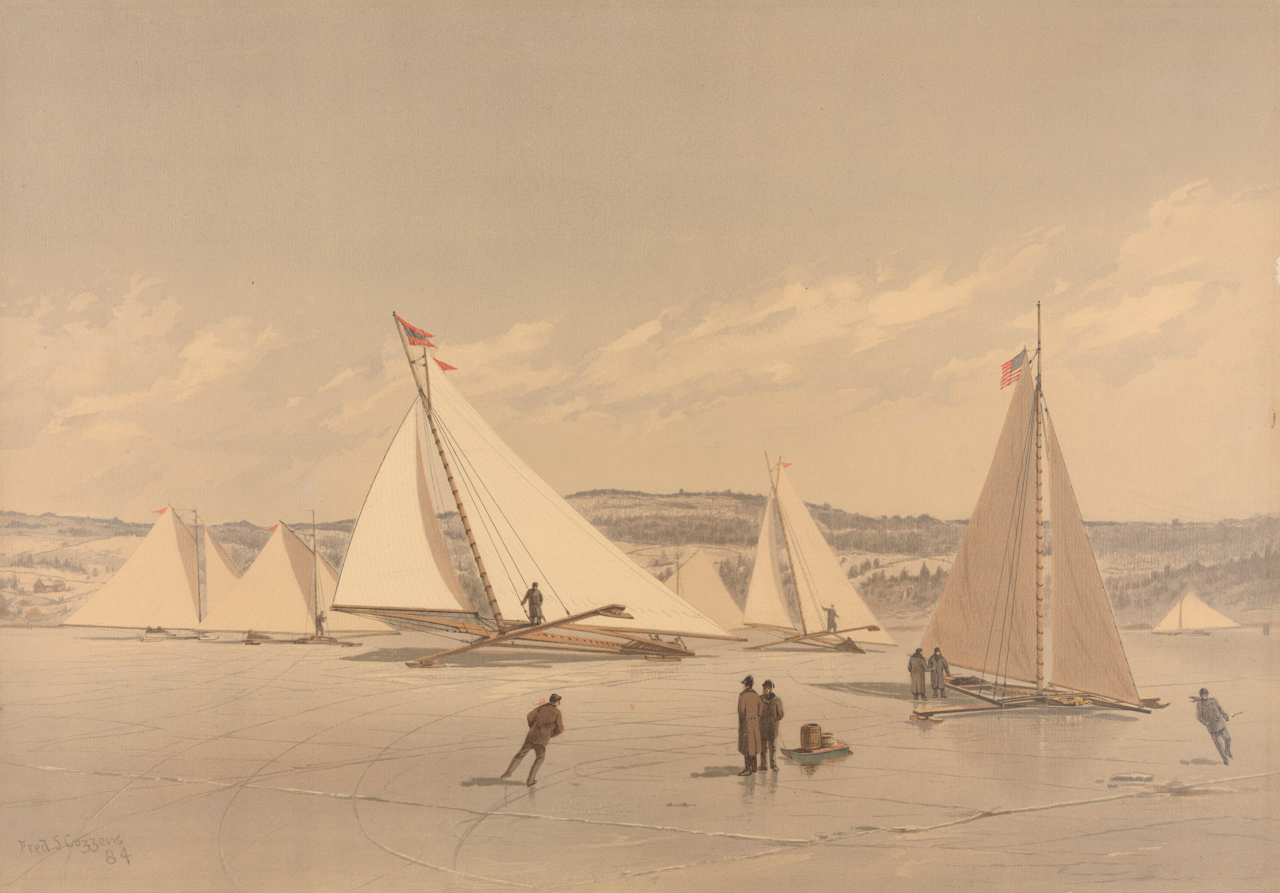
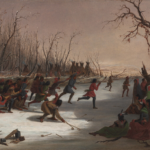
Ice boating on the Hudson” (1884) by Frederic S. Cozzens / Courtesy of National Maritime Museum, Greenwich
Ice sailing is a deeply cherished winter sport that has been passed down through generations in the Great Lakes region and is as entertaining to watch as it is to participate in. Developed in the seventeenth-century Netherlands as a way to transport goods between cities on canals in the winter, ice sailing has now become a fun winter pastime. Today, we’ll be delving into the history of ice-yachting in the Midwest, how ice-yachting is still alive and well today, and the basics of ice sailing.
History:
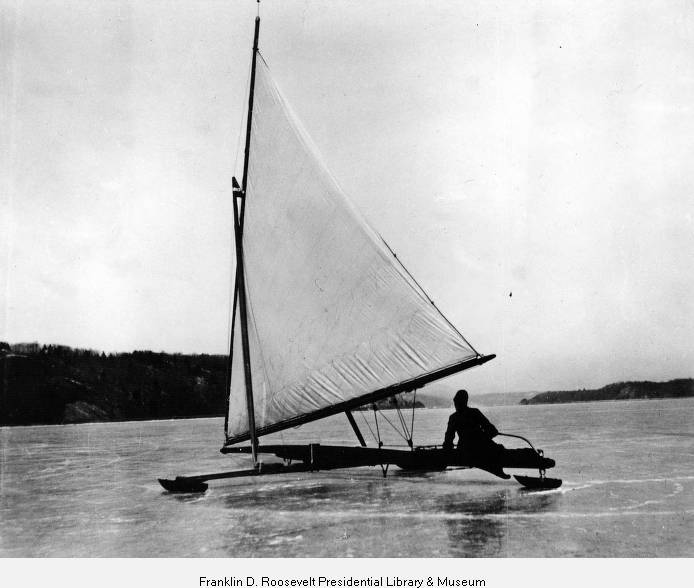
The first area in the United States to use ice boats was the Dutch settlements along the Hudson River. Similar to their families in the Netherlands, this winter practice started out as a practical method of transportation when travel proved more difficult in the winter months. Not only goods, but livestock and travelers would be transported from Athens to Albany, NY via ice sailing in the early 19th century (1). By 1861, the Poughkeepsie Ice Yacht Club was formed, where organized races became popular soon after. Franklin D. Roosevelt’s uncle, John A. Roosevelt, was an avid ice-boater and founded the Hudson River Ice Yacht Club in 1885, where he led as Commodore and Franklin D. Roosevelt as the Vice-Commodore (4). Soon, the sport spread to the Great Lakes States, with Michigan and Wisconsin becoming major hubs for racing. Some of the most notable lakes used historically were Lake St. Clair (MI), Madison (WI), and Williams Bay (WI) (3).
For many in the 1800’s, ice-sailing often left spectators awe-struck by the speeds sailors could reach. It was the fastest mode of transportation at the time. While many speeds can range anywhere from 40 mph to over 100 mph (5), the fastest ice-boat on record is said to have gone 143 mph in 1938 on Lake Winnebago (WI) (3).
Modern Ice-Sailing:
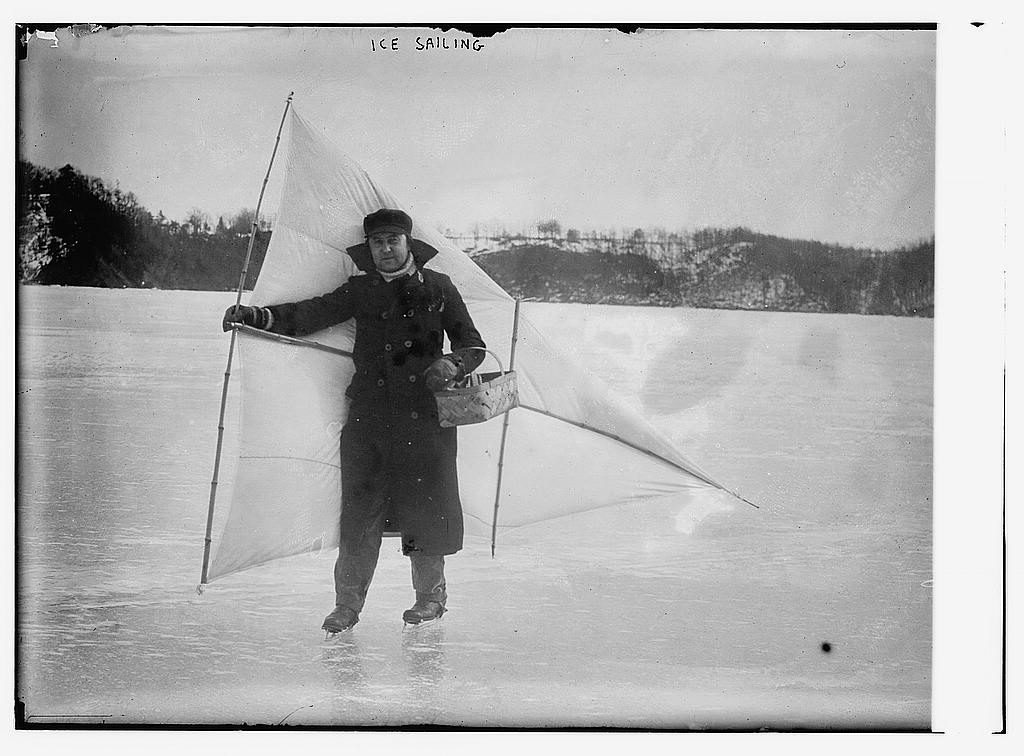
Today, ice-sailing locations can be found all over the Midwest. In addition to historical locations previously mentioned, places from Bowers Harbor (Traverse City, MI) to Lake Kegonsa (Stoughton, WI) now serve as racing locations. One of the most popular races in the Great Lakes region is the Northwest Regatta in Green Lake, WI, typically held in February.
Ice-Sailing Basics:
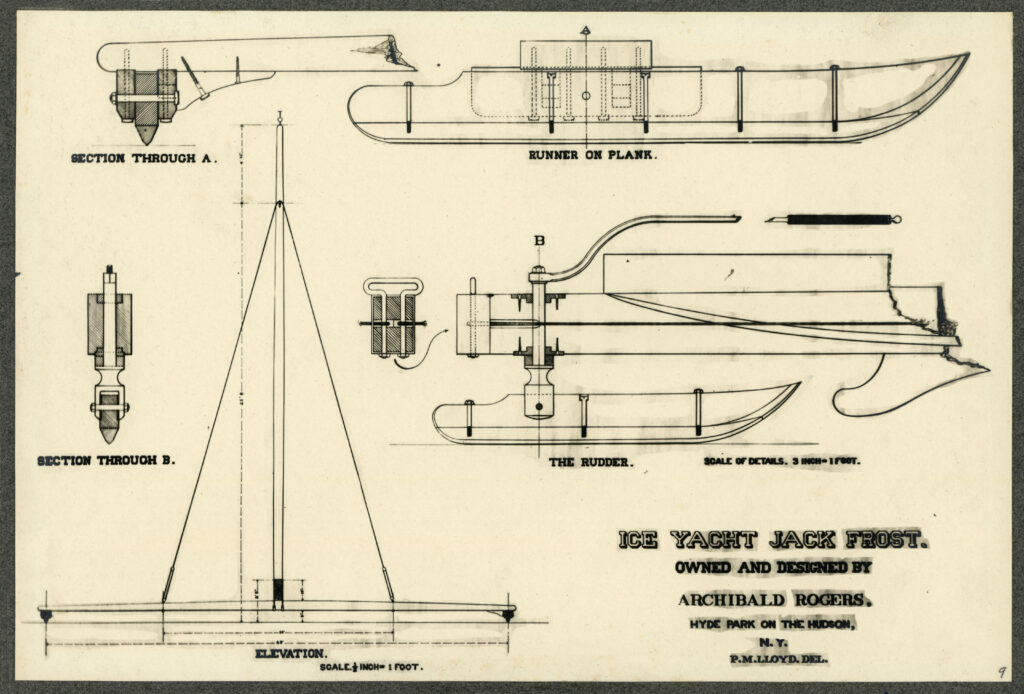
Let’s first discuss the basic construction of an ice-boat. An ice-boat consists of a backbone (a single fore-and-aft spar). It is mounted perpendicularly to a runner plank that contains steel runners on each end. There is a vertical mast that contains a jib and a mainsail. The sailor steers the boat by a tiller via a steering runner attached to the hull (2).
There are several rules and regulations that helmsmen must take into account during their race, including right-of-way rules, safety recommendations, and the layout of race courses (in-line, darling, or standard). These can all be viewed via the DN North America page here. Today, there are many ice-yachting clubs in the Great Lakes region that one can join to learn more about the sport and begin their ice-yachting journey. Some of these clubs are Grand Traverse Ice Yacht Club (MI), Four Lakes Ice Yacht Club (WI), Gull Lake Ice Yacht Club (MI), and North Star Sail Club (MI).
Conclusion
Ice yachting is more than a winter sport. It is a reminder that Great Lakes living has always required ingenuity, resilience, and a certain romance with the elements. What began as a practical solution in the frozen canals of the Netherlands found new life on Midwestern ice, carried forward by families, clubs, and generations of sailors who refuse to let winter quiet the water completely.
On the stillest days, when the lake is locked in glass, and the wind begins to rise, the runners hum, and the sails fill. For a few breathtaking moments, winter does not feel harsh. It feels alive.
And across the Great Lakes, it very much is.
Sources:
- National Park Service. (n.d.). Ice yachting on the Hudson. U.S. Department of the Interior. Retrieved February 16, 2026, from https://www.nps.gov/articles/000/ice-yachting-on-the-hudson.htm
- Encyclopaedia Britannica. (2026, February 4). Iceboating: Speed sailing, racing & history. Retrieved February 16, 2026, from https://www.britannica.com/sports/iceboating
- The Engines of Our Ingenuity. (n.d.). Iceboats on the Hudson. University of Houston. Retrieved February 16, 2026, from https://engines.egr.uh.edu/episode/2330
- Hudson River Maritime Museum. (2021, February). The ice yacht “Vixen”. Retrieved February 16, 2026, from http://www.hrmm.org/2/post/2021/02/the-ice-yacht-vixen.html
- North Shrewsbury Ice Boat & Yacht Club. (n.d.). What’s an iceboat? Retrieved February 16, 2026, from https://nsibyc.com/about/history-2/our-club/

Leave a Reply