
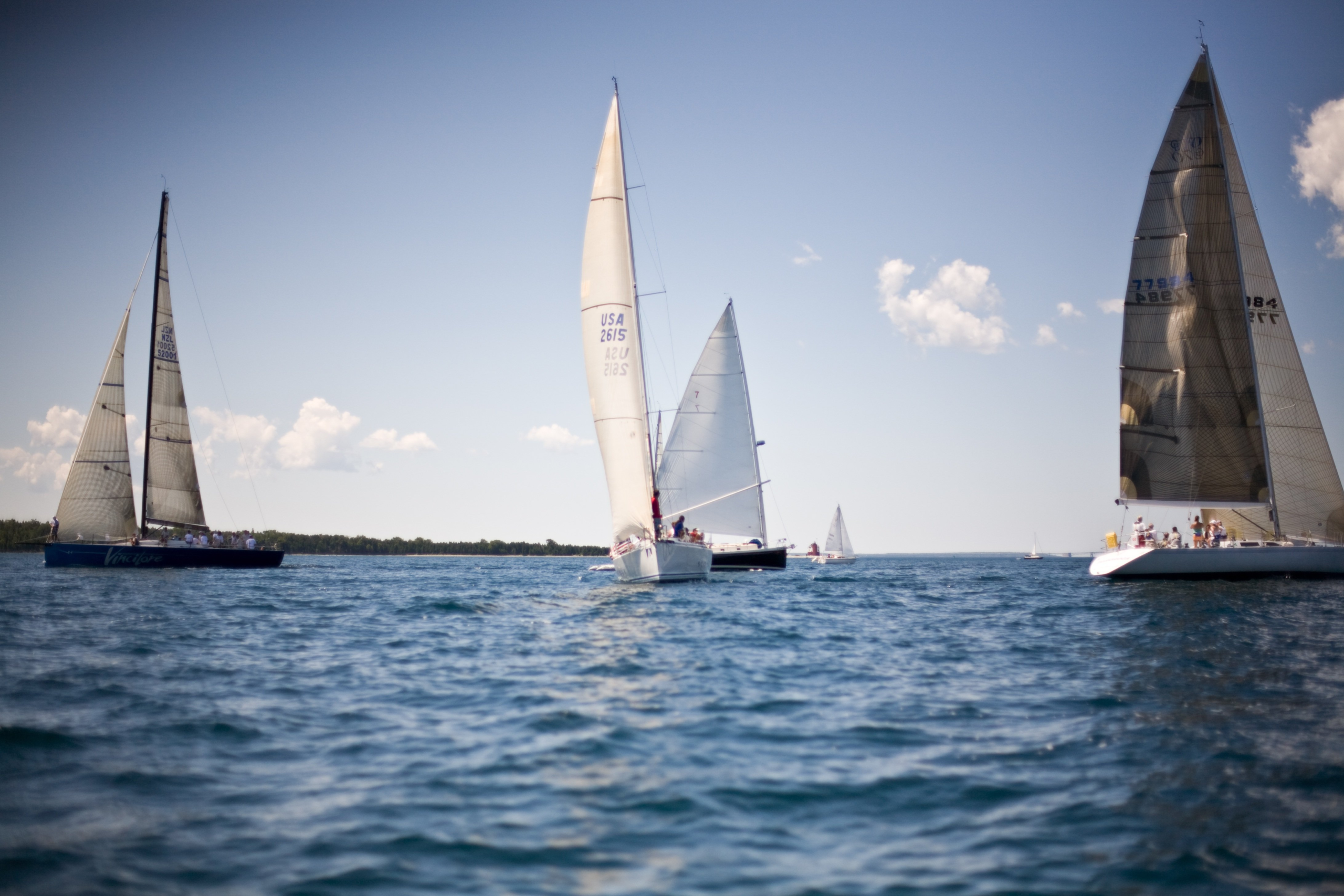
The Great Lakes were built by working sailors, fishermen, shipbuilders, and families who learned how to navigate the inland seas because they had to. Today, sailing classes on the Great Lakes carry that tradition forward for beginners eager to learn the wind.
Before pleasure craft dotted summer harbors, sails carried lumber, grain, iron ore, and entire livelihoods across the lakes. Schooners stitched together coastal towns. Small crews read the wind not for fun, but for survival. Sailing on the Great Lakes was not recreational. It was essential.
That legacy still lingers, even if the boats look different now.
Today, sailing ranges from quiet inland lakes to open-water races on Lake Michigan and Lake Erie. You’ll find weeknight regattas between neighbors, families rigging small boats at public launches, and adults in their thirties, forties, and beyond stepping into their first lesson after years of watching from shore.
Learning to sail in the Great Lakes region is not about status. It is about understanding something elemental.
When you begin to learn, you start noticing the wind in a new way. You feel its direction before you see it. You learn how a small adjustment to a sail can quiet a luffing edge and send the boat forward. You discover that movement on the water is not forced, but negotiated. The boat responds to patience and awareness far more than strength or frantic motion.
Modern sailing instruction reflects that philosophy. Beginner courses focus on foundational skills: terminology, safety procedures, steering with a tiller, trimming sails, docking calmly, and communicating clearly with crew. Whether you begin on a small dinghy that reacts instantly to every gust or on a larger keelboat that teaches teamwork and steadiness, the goal is the same. Building confidence through repetition.
Across Michigan, Wisconsin, Illinois, Indiana, Ohio, and Pennsylvania, there are schools and clubs that carry forward the tradition of sailing by welcoming newcomers onto the water and helping them develop a lifelong love for the sport.
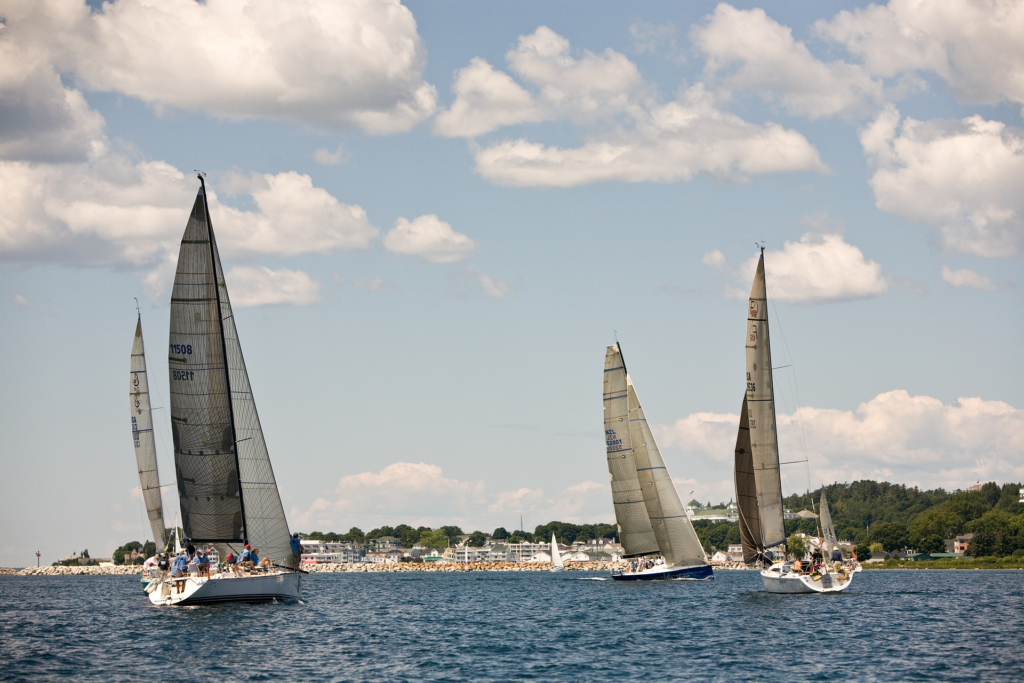
Sailing Classes Across the Great Lakes Region
Michigan
Bayview Yacht Club — Detroit
With more than a century of sailing history, Bayview offers adult learn-to-sail courses that focus on practical skills and confidence on the Detroit River. Many students begin with no prior experience.
Great Lakes Sailing Co. — Traverse City
An ASA-certified school on Grand Traverse Bay offering structured beginner courses. The bay’s protected waters make it a comfortable place to learn while still feeling like true Great Lakes sailing.
Michigan State University Sailing Center — Lansing
A particularly welcoming option for first-timers. Smaller boats and class sizes allow students to build fundamentals in a supportive setting.
Grand Rapids Junior Sailing Association — East Grand Rapids
Offering classes for students of all levels and ages on an inland lake. Adult classes meet once per week over six weeks and include both land-based and on-water instruction.
Wisconsin
Milwaukee Community Sailing Center – Milwaukee
True to its name, this center emphasizes access. Adult beginners are encouraged, and instruction balances fundamentals with hands-on time on Lake Michigan.
Green Bay Sail & Paddle – Green Bay
Focuses on affordable, community-based sailing, offering single-day intro classes, private, and team-building lessons.
Illinois
Columbia Sailing School — Chicago
Set against the skyline of Lake Michigan, Columbia offers adult sailing classes that welcome beginners into big-water conditions with guided instruction.
Chicago Yacht Club – Chicago
Structured ASA certification pathways that begin with foundational skills and progress at a comfortable pace for beginners.
Indiana
South Shore Sailing School – Michigan City
Offering summer day youth camps and evening adult classes with a focus on building skills steadily and safely.
Ohio
Learn to Sail Cleveland – Cleveland
Offering ASA-certified sailing courses for beginners to experienced sailors on Cleveland’s downtown waterfront.
Pennsylvania
Liberty Sailing School of Philadelphia – Philadelphia
An ASA-certified school offering classes for beginners on the historic Delaware River Waterfront.
What to Look for as a Beginner
The best sailing class is one that assumes you know nothing and treats that as a strength, not a liability. A strong beginner program will place you on the water early and often, allowing the feel of the wind to become familiar rather than theoretical.
You will learn how to steer with a tiller, how to trim sails so they work with the breeze rather than against it, and how to move safely around a boat that shifts beneath your feet. Some programs teach in smaller dinghies, where every wind change is immediate and instructive. Others use keelboats, which are steadier and introduce teamwork. Neither path is more legitimate. They simply build different instincts.
Look for instructors who translate technical language into understandable motion. You should leave your first lesson feeling challenged but not overwhelmed.
Most importantly, understand that sailing is learned by doing. You do not need to grow up around boats. You do not need a family history at a yacht club. You need curiosity and the willingness to listen to the wind.
A Note on ASA Certification
The American Sailing Association offers certification programs that require participants to complete both a written exam and an on-water assessment. ASA certification is not legally required to sail in the United States, but it is often necessary for chartering boats or international sailing. In addition, some insurance providers may require it as proof of experience, particularly for larger vessels.
If certification is something you want to pursue immediately, beginning with an ASA-affiliated course is a great first step. You can learn more about the ASA and search for ASA-affiliated schools on its website.
The Tradition Continues
When you sign up for a sailing class this summer, you are stepping into a long conversation between wind and water that has shaped this region for generations.
You will make awkward turns at first. You will forget a knot. You may over-trim a sail or misjudge a dock approach. That is part of it. Sailing is not mastered in a single lesson. It is accumulated slowly through repetition, attention, and time on the water.
And then, almost without noticing, something shifts.
The sails fill cleanly. The boat settles into its line. The shoreline begins to move past you with quiet steadiness. The wind is no longer something happening to you. It becomes something you are working with.
The boat beneath you becomes a partner.
And that partnership is open to anyone willing to begin.
Want to learn more? Read our blog on Ice Sailing, A Cherished Winter Pastime in the Great Lakes.
Sources
American Sailing Association. (n.d.). ASA certification system. Retrieved February 23, 2026, from https://asa.com/certifications/
US Sailing. (n.d.). Learn to sail. Retrieved February 23, 2026, from https://www.ussailing.org/education/
Lake Carriers’ Association. (n.d.). History of Great Lakes shipping. Retrieved February 23, 2026, from https://www.lcaships.com/
Great Lakes Historical Society. (n.d.). Great Lakes maritime history. Retrieved February 23, 2026, from https://www.glhs.org/



Leave a Reply