
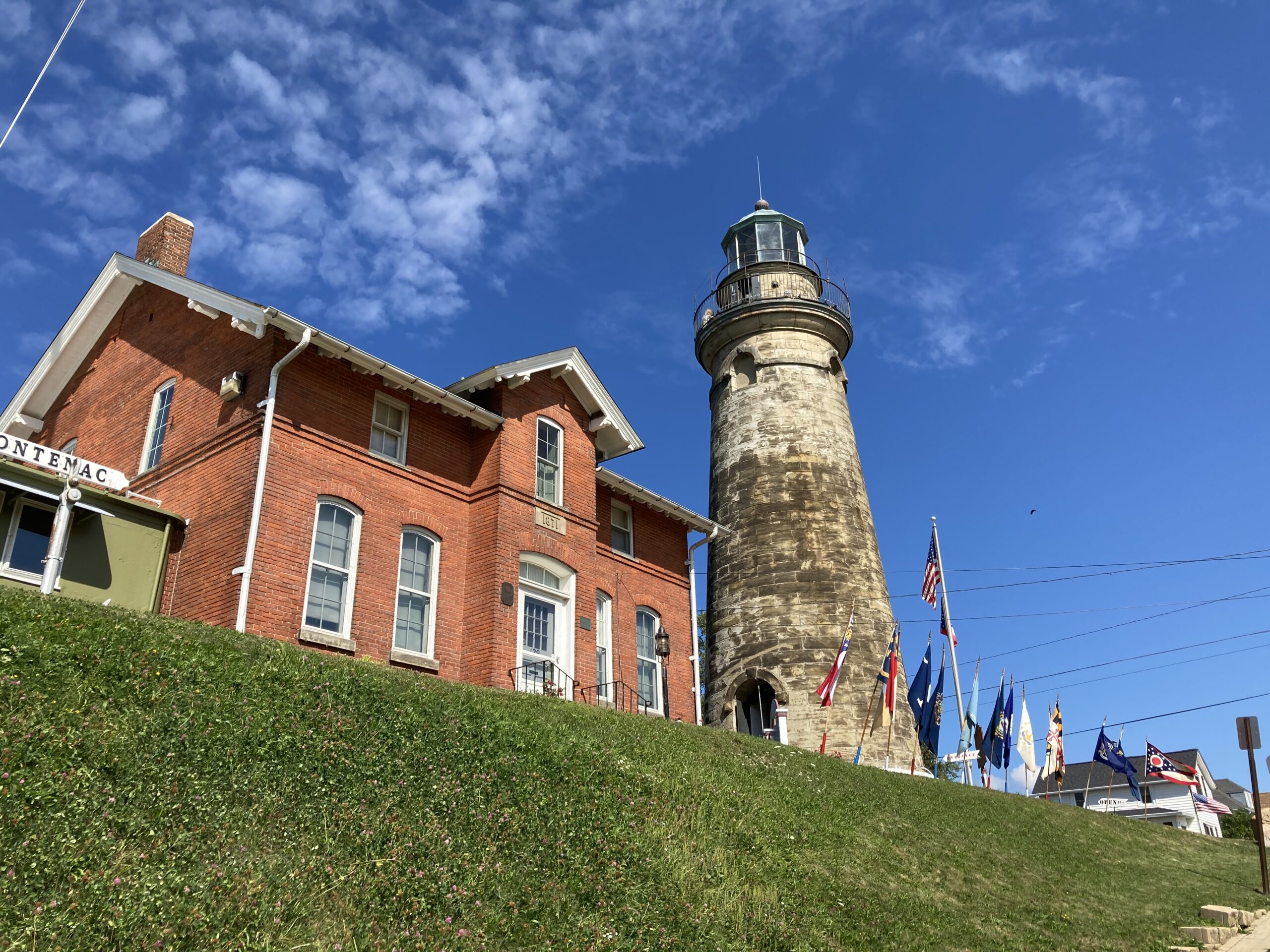
Photo courtesy of Fairport Harbor Historical Society
200 Years of Hope and Heritage with Fairport Harbor Lighthouse
Standing at the edge of Fairport Harbor on Lake Erie, the Fairport Harbor Light rises like a stone sentinel over the shore. For years, lighthouse keepers climbed the stairs here to watch over the mouth of the Grand River, guiding ships through the lake’s unpredictable waters. Today, the beacon is cared for by the Fairport Harbor Historical Society as the Fairport Harbor Marine Museum and Lighthouse, which became the first Great Lakes lighthouse marine museum in the United States in 1945. What many don’t realize as they look up at the tower is how close this landmark came to disappearing. Saved from demolition by passionate locals and run entirely by volunteers to this day, the lighthouse stands as a lasting testament to a community that refused to let its story be erased.
How Fairport Harbor Lighthouse Came to Be

First constructed in 1825, the original light was built to help cargo vessels navigate into the young Western Reserve by marking the river mouth. Designed by architect Jonathan Goldsmith and built by Hiram Wood for roughly $2,900 (almost $100,000 in today’s dollars), the thirty-foot brick tower stood alongside a separate two-story keeper’s house.
DID YOU KNOW?
The Painesville Telegraph published the original notice in 1825 requesting bids for a lighthouse and Keeper’s dwelling. The proposal specified materials to be used, depth of the foundation, height, diameter of the soapstone deck, and size, number, and shape of the windows. Fairport Harbor was one of only eight lighthouses on the Great Lakes when it was built.
Samuel Butler, the lighthouse’s first keeper, was also one of the village’s dedicated abolitionists. In later years, he ran the Eagle Tavern and organized locally against the Fugitive Slave Act of 1850, the law that made it a federal crime to help anyone escaping slavery, even in a free state like Ohio.
According to historians at the Fairport Harbor Historical Society, the lighthouse became a sanctuary on the Underground Railroad, kept by a network of sympathetic captains, sailors, keepers, and neighbors. Freedom seekers moved quietly through the village by way of the nearby Parmley Mansion, then waited for signals between the shore and ships offshore that would carry them across Lake Erie to Canada. They sometimes hid in the lighthouse itself or in the cellar of the original keeper’s house. As many as 500 people are estimated to have passed through Fairport on their way to freedom.
These courageous efforts are why the lighthouse has come to be known as the Freedom Light. The lantern beam served as more than a navigational aid for mariners; it was a beacon of hope for those escaping slavery.
By the late 1860s, years of enduring severe weather on the lakeshore, along with a foundation that was only two feet deep, left the original tower in hazardous condition. In 1869, Congress appropriated $30,000 for a new tower and keeper’s dwelling, and construction began the following spring. On August 11, 1871, the new light was lit for the first time. Towering sixty feet tall, double the height of the original, it was constructed of Berea sandstone and equipped with a third-order Fresnel lens visible eighteen miles out on the lake. This is the same tower that still stands over the harbor today.
DID YOU KNOW?
Lake Erie is the shallowest of the Great Lakes, which causes violent, short-period waves to build up within minutes. Waves can get up to 20 feet high, catching ships and swimmers off guard. In addition, Lake Erie’s unique southwest-to-northeast orientation allows strong winds to push massive amounts of water to one side of the lake, creating a seiche. This standing wave can raise water levels by several feet at one end while exposing the lakebed and draining docks at the other.
The light served Fairport for another half century. In 1925, the government decommissioned it in favor of the new West Breakwater Light, and the old tower went dark. For a while, it looked like that would be the end of its story.
The Fight to Save the Light

Following its decommissioning, the landmark faced imminent demolition. Unwilling to watch their history destroyed, local residents launched a passionate letter-writing campaign. Civitan International, the Daughters of the American Revolution (DAR), the Kiwanis Club, and two U.S. senators pleaded the case directly to Commerce Secretary Herbert Hoover.
“The lighthouse was such an integral part of the community, its heritage
Marty O’Gara
and history, that the villagers refused to let it be demolished.“
President, Fairport Harbor Historical Society
Rescuing the structure from being demolished was only the first battle. For nearly twenty years, the empty tower stood quiet. Then, on March 17, 1945, a group of dedicated residents founded the Fairport Harbor Historical Society to convert the former keeper’s residence into a museum. The first display room opened that summer. On July 2, 1946, during the village’s 150th anniversary, the museum was officially dedicated.
The village assumed ownership of the site in 1953, leasing it back to the Historical Society. In 1971, the property was listed on the National Register of Historic Places. Through every era, the doors have remained open thanks to volunteers giving their time back to a light that saved so many lives.
“It makes me proud to be a part of the organization that has literally
Marty O’Gara
kept the doors open since 1945, when the museum was established.“
President, Fairport Harbor Historical Society
Last year, community members gathered at the mouth of the Grand River to mark the site’s 200th anniversary.
“It was a feeling of awe and accomplishment when I stood at the mic and looked
Marty O’Gara
at the large crowd gathered for the event. I knew all the effort and all the bumps
along the road, but we had worked together to make it happen.”
President, Fairport Harbor Historical Society
Inside the Museum

Stepping into the old keeper’s residence leads visitors through three distinct exhibit rooms filled with regional maritime artifacts. The Founder’s Room showcases gear and artifacts from U.S. Coast Guard Station Fairport, along with salt samples from the Morton mine beneath Lake Erie. The Fairport Room tells the history of the lighthouse and is home to the third-order Fresnel lens from the 1871 tower. The Great Lakes Room chronicles shipping, wooden boatbuilding, and life across the Great Lakes.
Outside, visitors can step aboard the attached pilothouse of the retired Great Lakes freighter Frontenac. The flagpole standing in the front yard was repurposed from the mast of the USS Michigan (renamed the USS Wolverine in 1905), the Navy’s first iron-hulled warship. Nearby, a rare clockwork rotating mechanism from Michigan’s Little Sable Lighthouse is also on display.
Among the exhibits, one interesting artifact on display continues to draw consistent curiosity from visitors. A mummified cat was discovered in 2001 within a crawlspace under the museum. Local lore connects it to “Sentinel,” a pet given by Captain Joseph Babcock to his bedridden wife in the late 19th century. When Sentinel mysteriously vanished, Mrs. Babcock was heartbroken and passed away shortly after. Decades later, a former resident curator living in the keeper’s house between 1987 and 1991 reported frequent ghost sightings of a cat darting across the room and in Mrs. Babcock’s former bedroom. The mysterious ghost cat has since been featured on television programs like Animal Planet’s The Haunted and the Biography Channel’s My Ghost Story.
Two Centuries and Counting

Time and again, Fairport Harbor has served as a symbol of hope: for sailors searching for safe harbor, for freedom seekers risking everything for a new life, and for locals who fought to preserve their heritage.
The people preserving the site today are neighbors and passionate newcomers alike. Operating without a paid staff, they open the museum each season, manage the collection, design fresh exhibits, and guide visitors up the tower stairs. The same spirit that saved the tower a century ago keeps it thriving today.
“When I moved to Fairport, I had retired and was looking for volunteer opportunities.
Marty O’Gara
I love being near the water and history, so the lighthouse appealed to me.“
President, Fairport Harbor Historical Society
During a recent season, the museum featured a special exhibit on the Clough, a Lake Erie vessel lost in 1868 and rediscovered more than 150 years later.
If your travel plans bring you to Northern Ohio next season, be sure to make time for Fairport Harbor. Step up the sixty-nine steps, take in the view across the lake, and spend time with the community keeping two hundred years of Great Lakes history alive.
To plan a visit or learn more about the Society’s preservation work, visit https://fairportharborlighthouse.org.
Special thanks to the Fairport Harbor Historical Society for reviewing and verifying the historical details in this article.
Interested in learning more about Lake Erie lighthouses? Read our article on the history of Marblehead Lighthouse.
Sources
- “Fairport Harbor Marine Museum & Lighthouse.” Fairport Harbor Historical Society. fairportharborlighthouse.org
- “Fairport Harbor Lighthouse History.” Fairport Harbor Historical Society. fairportharborlighthouse.org
- “The Ghost Cat.” Fairport Harbor Historical Society. fairportharborlighthouse.org
- “Museum Highlights.” Fairport Harbor Historical Society. fairportharborlighthouse.org
- O’Gara, Marty, President, Fairport Harbor Historical Society. Interview responses, September 2026.
- “Fairport Harbor Lighthouse.” Lighthouse Friends. lighthousefriends.com
- “Fairport Harbor Lighthouse: The Freedom Light.” The Keeper’s Log, United States Lighthouse Society. uslhs.org
- “The Fairport Harbor Marine Museum and Lighthouse Shines a Light on Great Lakes History.” Ohio Magazine. ohiomagazine.com
- “Seiche Events on Lake Erie.” New York Sea Grant. seagrant.sunysb.edu
- “State of Ohio Hazard Mitigation Plan, Section 2.8.” Ohio Emergency Management Agency. ema.ohio.gov


Leave a Reply