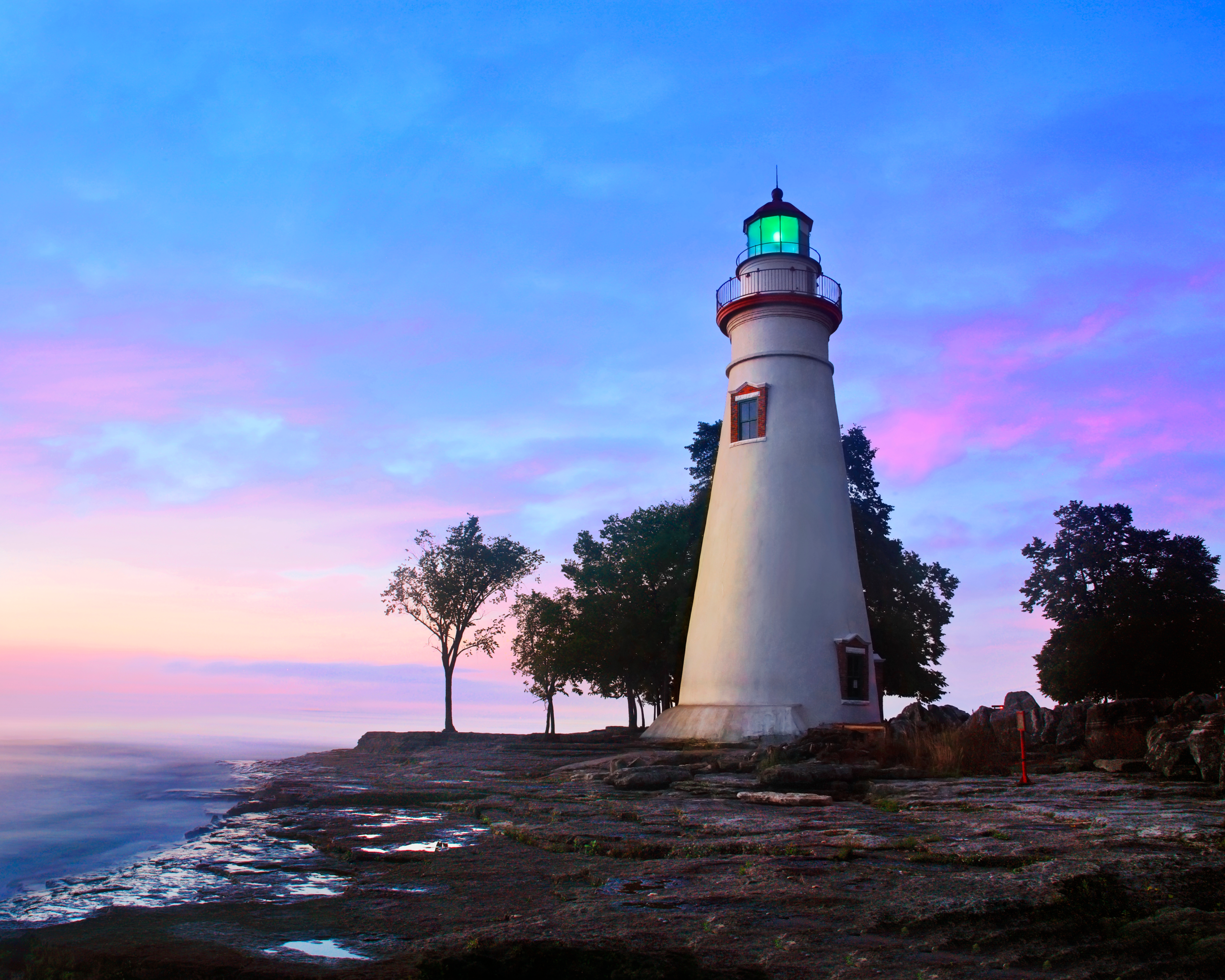
Cold air hangs low over Sandusky Bay, blurring the line between open water and morning sky. Through the heavy fog, a brilliant green beam blinks every six seconds from a lone white stone tower at the edge of the shore. For more than two centuries, through gale-force winds and frozen winters, Marblehead Lighthouse has guarded those exploring these waters, standing as the oldest continuously operating lighthouse on the Great Lakes.
Did you know?
According to the United States Lighthouse Society, Marblehead Lighthouse is the third-oldest lighthouse built on the Great Lakes and the second-oldest on Lake Erie.
Why Lake Erie Needed Marblehead Lighthouse
In the nation’s early years, lighthouses were a national priority. Trade meant tax revenue, and tariffs were one of the few ways a cash-poor federal government could fund itself. In 1789, Congress passed the Lighthouse Act, putting the country’s existing lighthouses under federal care and Treasury Department oversight for the first time.
Ohio had only been a state for a decade when the War of 1812 broke out between Britain and the United States. The British capture of Detroit in August 1812 showed how crucial Lake Erie was, since holding it meant control over supply lines, troop movement, and the region’s best defense against a British invasion from the north. Commodore Oliver Hazard Perry’s 1813 win over the British fleet at the Battle of Lake Erie put most of the lake under American control, opening up the trade route running past Sandusky Bay, long considered the safest harbor between Cleveland and Toledo.
A few years later in 1819, Congress set aside $5,000 to mark the bay’s entrance with a light, then authorized another $5,000 the following year to finish the job. William Kelly, Sandusky’s first stonemason, was hired to construct a fifty-foot limestone tower with six assistants by November 1821. The limestone used to build the tower was quarried from the Marblehead peninsula, and the tower itself sits directly on bedrock, with no separate foundation underneath it.
Did you know?
The rock under the Marblehead Peninsula and the nearby Lake Erie islands was formed hundreds of millions of years ago, when a warm, shallow sea covered what’s now Ohio, leaving behind thick beds of calcium carbonate built up from the remains of ancient marine life, corals, and shellfish among them. It’s the same limestone that made the region a quarrying center for generations afterward.
The lighthouse was originally named the Sandusky Bay Light, its name until 1870. The tower base is about 25 to 26 feet in diameter with walls five feet thick, narrowing to just 12 feet across with two-foot walls at the top. Between 1897 and 1903, the tower was raised roughly 15 feet with the addition of a new watch room and lantern room, bringing the tower’s height to sixty-five feet.
Benajah Wolcott, a Revolutionary War veteran from Connecticut, was appointed the first keeper in 1822 by President James Monroe. He married Rachel Miller that same year and built a limestone house, along with a 114-acre farm, about three miles from the lighthouse. He held this post for ten years, earning an annual reported salary of $350, until his death from cholera in 1832. Benajah contracted cholera after finding and burying bodies of cholera victims who washed ashore after being tossed overboard from passing ships, a common practice in the day.
Following his death, the U.S. Treasury Department appointed his widow, Rachel Miller Wolcott, as keeper. She is credited by the Ottawa County Historical Society as the first female lighthouse keeper on the Great Lakes. Keeping the light alone as a widow with young children and a farm to manage was demanding work. Roughly two years later, she married again, to Jeremiah Van Benschoten, a Dutchess County, New York transplant who took over as the lighthouse’s third keeper.
“The life of a lighthouse keeper was not easy. The keepers, in addition to raising a family, maintaining a household, cooking, cleaning, sourcing food, and refueling the lamps, had to polish the brass, carry 80 pounds of whale oil to the top of the lighthouse every night, watch for sailors in distress, and complete general repairs. They often lived solitary lives, as the location of lighthouses was far from other residents. Often they went days, weeks, or even months without human interaction. In addition to being physically exhausting, the life of a lighthouse keeper was often mentally draining as well.“
Heidi M. Chew Osborne, Executive Director Marblehead Lighthouse Historical Society
Fifteen keepers in total tended the light before automation, two of them women. In 1939, President Roosevelt’s Reorganization Order folded the U.S. Lighthouse Service into the Coast Guard nationwide, which remains the official keeper of record for every American lighthouse today. Locally, Marblehead’s last civilian keeper, Edward Herman, resigned in 1943 after ten years of service, after which Coast Guard personnel staffed the light until it was automated in 1958.
The Keeper’s Houses
Still standing today is the Wolcott Keeper’s original house, built in 1822, on East Bayshore Road. It was one of the first permanent houses on the peninsula, and is now the oldest surviving house in Ottawa County, listed on the National Register of Historic Places. The Ottawa County Historical Society restored it in 1989, and it’s open seasonally for tours.
The second is the Keeper’s House Museum, built in 1880 directly beside the tower itself, replacing an earlier dwelling on the same spot. This house was available to whichever keeper held the post. When there was an assistant keeper on staff, he lived on the second floor while the head keeper lived on the first. Today it operates as a museum, gift shop, and headquarters for the Marblehead Lighthouse Historical Society.
Unlike a standard solid lens, a Fresnel lens uses a series of concentric glass prisms to bend light inward, turning a modest flame or bulb into a powerful, far-reaching beam. French physicist Augustin Fresnel developed the design in the early 1820s, and his design is why lighthouses could suddenly be seen from much farther out on the water than older reflector systems allowed. Lenses came in six sizes, called orders, from the small sixth-order up to the massive first-order lenses used to guard the most exposed ocean coastlines.
Marblehead’s light changed more than once. In 1858, the original whale-oil lamps were replaced with a single kerosene lamp and a fixed fourth-order Fresnel lens, providing a meaningful jump in brightness. By the 1890s, ships had grown larger and drifted farther from shore as they needed deeper water, which meant Marblehead needed a light that could be seen at a greater distance.
A stronger light needed a bigger lens, and a bigger lens needed a wider lantern room, but the tower’s original shape narrowed as it rose and couldn’t support a heavier top without help. In 1897, they removed several feet of the original stone and built a circular brick liner up from the base, one that could support a taller, wider top. In 1901, workers installed a larger lantern room recycled from Pennsylvania’s decommissioned Erie Land Light. Then in 1903, a 3½-order Fresnel lens arrived from Paris and was installed on a rotating clockwork mechanism, making the light flash every ten seconds instead of being a fixed light.
This 1903 lens served the tower until 1969 and is now on display at the museum.
“The Fresnel Lens is a must-see. It weighs 1,440 pounds and has 128 crown glass prisms which magnify the light.“
Heidi M. Chew Osborne, Executive Director Marblehead Lighthouse Historical Society
The light itself kept evolving after that. Kerosene gave way to electric bulbs in 1923, increasing the beam’s strength from roughly 42,000 to 350,000 candlepower. Today’s light runs on LEDs installed in 2013, flashing green every six seconds and visible about 11 nautical miles out. The green light distinguishes the lighthouse signal from the white glow of air beacons, helping sailors identify their exact location on marine charts.
The Historical Society That Saved the Light
By 1998, Marblehead was at risk of being decommissioned or torn down entirely as the federal government looked to shed surplus lighthouse properties. Residents organized to save it, forming the Marblehead Lighthouse Historical Society and working with the state to establish Marblehead Lighthouse State Park. The Marblehead Lighthouse Historical Society is a volunteer-run nonprofit whose stated mission is “to preserve the history and customs of the Marblehead, Ohio area and its Historical Lighthouse.” It leases the Keeper’s House Museum and gift shop from the Ohio Department of Natural Resources and staffs it entirely with volunteers.
Today the museum includes the Fresnel lens, information about lighthouses in general, a replica of the local lifesaving station, and material on regional shipwrecks. Tower climb tours run seasonally, typically Memorial Day weekend through Labor Day weekend, daily from noon to 4 p.m., with tickets required.
Since forming in 1998, the society has funded a string of preservation projects on the property, including the lifesaving station replica and a quarry exhibit tied to the peninsula’s own limestone history.
Right now, the society’s biggest preservation focus is inside the tower itself. When the lighthouse was raised in 1897, the new brick liner built to support the taller structure ended up in direct contact with the original limestone. Moisture trapped between the two materials has caused serious frost damage to the brick.
“The moisture within the tower has caused some severe frosting of the brick, allowing for continued sanding of the brick faces. The coatings have fallen off to be swept away each and every spring.”
Heidi M. Chew Osborne, Executive Director Marblehead Lighthouse Historical Society
Every October, Lakeside Chautauqua and Marblehead Peninsula Chamber of Commerce host the Lighthouse Festival, a free, peninsula-wide celebration spanning both Lakeside Chautauqua and the Village of Marblehead. This day brings awareness to the historic buildings tied to Marblehead’s history, helping attendees learn more about the important role these spaces have played in the development of the region. Activities also include arts and crafts vendors, a farmers market, live entertainment, children’s crafts, specials at local businesses, and more.
This year’s festival takes place on October 10th, 2026, and will include the lighthouse, museum and gift shop, and the U.S. Lifesaving Station all being open from 9:00 a.m. to 4:00 pm. The historical society is completing a large landscaping project at the base of the lighthouse that they hope to have completed for visitors to see during the festival.
Passing the Flame
It is impossible to count the lives this tower has touched over two hundred years. The countless crews who scanned the horizon through blinding snow or heavy fog, yearning for that single flash of light that meant safety, warmth, and home owe their lives to this lighthouse and its keepers. To those sailors, the beacon wasn’t just a navigation point. It was proof that a stranger on shore was standing guard, and that someone out there cared about their life.
A tower like Marblehead only survives two centuries if someone chooses to care for it every single day. In 1832, that meant a widow carrying eighty pounds of oil up a cold, dark staircase to keep those strangers alive on the water. Today, it means local volunteers restoring the brick, sweeping the lantern room, and raising funds so every new generation can watch that green light flash across the bay.
Marblehead isn’t just the oldest operating light on the Great Lakes because it was built well. It is still shining because for over two centuries people have chosen to care for what matters most: each other and the places they call home.
“History of Lighthouses in the United States.” National Park Service. nps.gov
“Resolution Marking Bicentennial of Battle of Lake Erie.” Ohio House of Representatives. ohiohouse.gov
“The Battle of Lake Erie: A Turning Point in the War of 1812.” Pennsylvania Center for the Book, Penn State University Libraries. pabook.libraries.psu.edu



Leave a Reply