
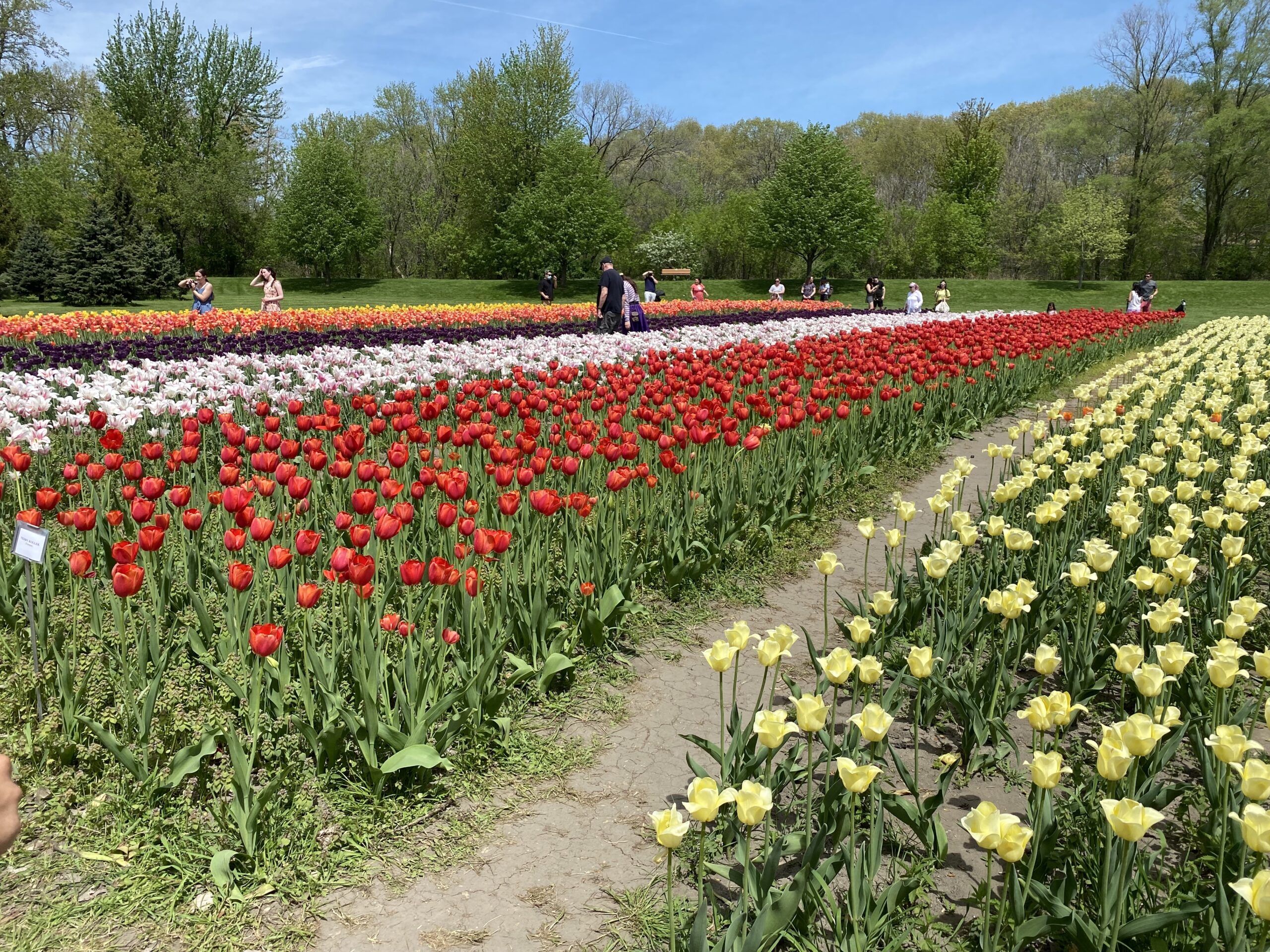
There is a week in early May when the western side of Michigan leans heavily into its heritage, which is deeply, stubbornly, and beautifully Dutch.
Holland, Michigan, sits about 30 miles southwest of Grand Rapids along the Lake Michigan shoreline, and for most of the year, its Dutch heritage hums quietly in the background. The architecture. The family names. The way people say “ope,” hold doors open, and show up for their neighbors without being asked. But when the first tulips crack open along 8th Street, something shifts, and the Dutch comes out in full.
This is known as Tulip Time. And it’s one of the oldest, most deeply rooted community festivals in the country.
A Biology Teacher, a Poem, and 100,000 Bulbs
The origin story of Tulip Time is almost too charming to be real, but it is.
In 1927, a Holland High School biology teacher named Lida Rogers stood up at a meeting of the Women’s Literary Club and gave a talk she titled “Civic Beauty.” She spoke about the sand dunes, the trees, and the clean water. She talked about what made Holland special. And then she suggested that the city adopt the tulip as its official flower, plant them in every yard, and set aside a day to celebrate.
She closed by reading a poem: “Come Down to Holland in Tulip Time.”
It worked.
By 1928, the city council had purchased 100,000 tulip bulbs from the Netherlands, and in May of 1929, those bulbs bloomed for the first time. Holland invited visitors in, and the tradition stuck. It has been happening every single year since, with the exception of a pause during World War II, when the festival was replaced with smaller flower shows and musical events before returning in full in 1946.
Today, more than five million tulip bulbs are planted across the city each year. They line six miles of designated “Tulip Lanes” along neighborhood curbs, fill Centennial Park and Window on the Waterfront, carpet the grounds of Windmill Island Gardens, and bloom across acres at Veldheer Tulip Farm on the city’s north side.
Local Favorites
The street scrubbing. Before the Kinderparade steps off, you’ll see groups of locals in Dutch costumes take to the streets with brooms and buckets of water, scrubbing the pavement clean. It’s a nod to the Dutch reputation for fastidious cleanliness, and it has been part of the festival for decades. Governors have participated. Governor Kim Sigler was the first in 1947, and every Michigan governor since has donned a costume and picked up a broom. Governor George Romney once made the “People” page of Time Magazine doing it.
Klompen dancing is a varsity sport. At some Holland-area high schools, Dutch dancing carries varsity status. Kids learn the choreography the way other towns learn football plays. Over 1,400 dancers now perform during the festival, from third graders in the Kinder groups to alumni ensembles made up of married couples who practice together on Wednesday nights and go out for dinner afterward. The costumes are handmade by local seamstresses, individually inspected, and patterned after traditional dress from the Dutch provinces. Dancers wear multiple pairs of socks inside their wooden klompen and perform for hours.
The community tulip dig. This is the one the tourists rarely hear about. A few weeks after the festival ends, a local nonprofit called Holland in Bloom partners with the city to host a community tulip dig. For $10 cash per five-gallon bucket (bring your own), residents and visitors can show up at Centennial Park, Window on the Waterfront, or Windmill Island Gardens and dig up tulip bulbs to take home and replant in their own yards. They have to be removed anyway, as the city plants annuals in those beds for summer color, and the irrigation schedule would rot the bulbs if they stayed in the ground. So instead of composting them all, they invite people in. First-come, first-served, with some locations running out before 11 a.m.
The fall planting days. Every October, nearly 100 volunteers, including residents, business owners, and visitors, gather over two days to plant 100,000 bulbs by hand. The Holland Parks Department follows with another 400,000 bulbs across 127 varieties. The planting tools vary depending on the site: hand poles that punch individual holes for smaller beds, and a custom-built machine that carves a foot-wide trench along the curb for the tulip lanes. It is a massive, coordinated effort that happens months before anyone shows up for the festival.
What It Feels Like Now

Tulip Time 2025 drew nearly 976,000 visitors, up 30 percent from the year before. The economic impact topped $50 million. The festival has been named “Best Flower Festival” by USA Today, “Best Small Town Festival in America” by Readers Digest, featured on Fodor’s list of America’s best spring flower festivals, and honored as “Tulip Festival of the Year” by the World Tulip Summit.
But the remarkable thing about Tulip Time is that it feels like a community festival, not a corporate production. There is no single admission ticket; events are individually ticketed, and many of them are free. You can walk through Centennial Park, watch Dutch Dancers perform on the street, and wander the tulip lanes without spending a cent. The Kinderparade is still led by elementary school kids in Dutch costumes, and the Volksparade still fills 8th Street with floats and marching bands wearing wooden shoes.
This year, the festival runs May 1 through 10, 2026. New programming includes “Dutch Life on Display,” an exhibit at the Van Raalte Farmhouse showcasing traditional clothing and heritage from the Netherlands. The Tulip Immersion Garden returns with 50,000 raised tulip beds arranged in three displays that trace the flower’s journey from its origins in Central Asia and Turkey, through the Netherlands, and finally to Holland, Michigan. And the klompen dancers are back on the streets, performing throughout the day, every day, for the full ten days.
The final Saturday night closes with a lighted drone show and fireworks over Kollen Park.
Why It Matters
Holland, Michigan, was founded in 1847 by Dutch immigrants led by Albertus Van Raalte. A devastating fire leveled the city in 1871, and it was rebuilt. The community sent aid to the Netherlands during and after World War II, and those ties of mutual care deepened what had already been a strong cultural connection. The tulips that bloom every May are not decorative. They are a living thread connecting this lakeshore city to a homeland an ocean away.
Holland has demonstrated what it means to stay connected to your roots, no matter the time or distance. It takes a town full of people who show up every October to plant bulbs they won’t see bloom for seven months. It takes seamstresses who hand-stitch provincial costumes and dancers who practice in wooden shoes on Wednesday nights. It takes a biology teacher who stands up at a club meeting and reads a poem about civic beauty.
It’s the kind of tradition that reminds you what a place can be when people decide to care for it on purpose.
We’ll See You There
Highland & Harbor is looking forward to Tulip Time 2026. This festival represents so much of what we love about the Great Lakes region: deep roots, living traditions, and a community that shows up for itself season after season. It’s one of the most genuinely beautiful weeks in Michigan, and it belongs to all of us.
We hope to see you in Holland.
Tulip Time 2026 runs May 1 through 10 in Holland, Michigan. For event details and tickets, visit tuliptime.com.
Interested in more Great Lakes heritage events? Check out our blog on The History of the Minnesota Governor’s Fishing Opener here.


